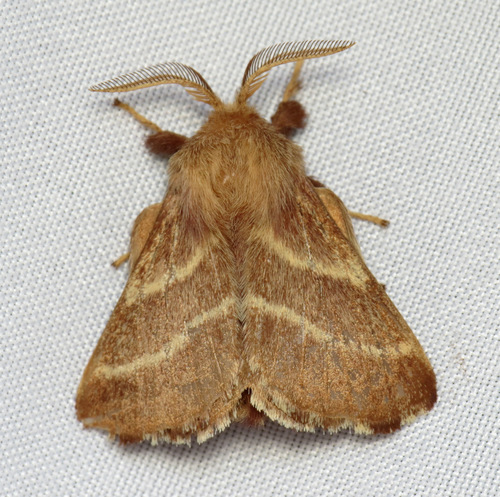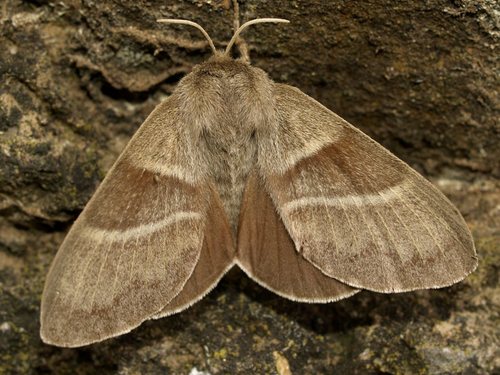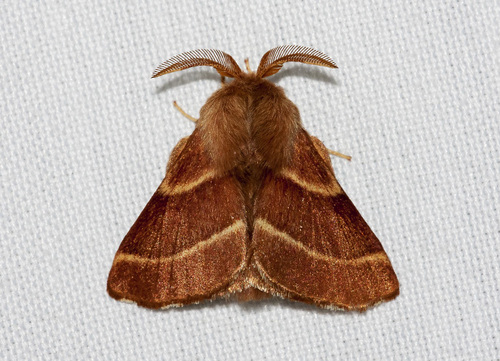
About Gonometa postica Walker, 1855
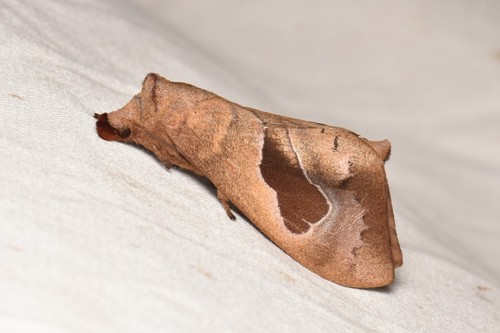
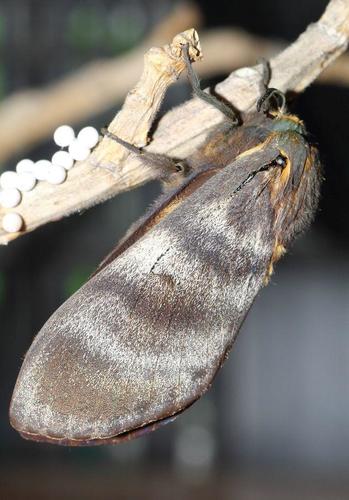
Gonometa postica Walker, 1855, commonly called the African wild silk moth, burn worm, and brandwurm, is a large species of African moth in the family Lasiocampidae. The genus Gonometa includes some very large moths and larvae; for example, the African species Gonometa sjostedti has a larva that reaches 16 centimeters long. Most species in Lasiocampidae are highly sexually dimorphic. For G. postica, male forewings measure 21–25 mm, while female forewings measure 35–42 mm. Traditionally, cocoons of Gonometa postica and Argema mimosae are used as ankle rattles by San and Bantu tribes in southern Africa. The cocoons are filled with materials including fine gravel, seeds, glass beads, broken sea shells, and pieces of ostrich eggshell. This species is notable for producing high-quality wild silk inside its cocoons. Cocoons are harvested commercially in Namibia, Botswana, Kenya and South Africa, and the species is also found in Zimbabwe and Mozambique. A research team from Oxford University found that cocoon surfaces are covered in calcium oxalate, which blocks commercial use of the silk. The team discovered and patented a demineralization method that uses a warm solution of EDTA (ethylenediaminetetraacetic acid). This process softens cocoons by dissolving sericin, allowing silk to be unravelled without significant loss of strength. G. postica cocoons are also sexually dimorphic: female cocoons are roughly twice the size of male cocoons, so they produce more silk. The sex ratio of natural populations therefore has a large impact on cocoon harvest. G. postica larvae have quite variable patterning, and like most species in the genus Gonometa, they are covered in irritating setae (hairs). Mature larvae are black with lateral tufts of white, yellow, or orange. They have been recorded feeding on Acacia, Brachystegia, Elephantorrhiza, Pinus radiata, and Julbernardia. Another silk-producing species in the genus is Gonometa rufobrunnea Aurivillius, 1927, which feeds almost exclusively on Colophospermum mopane. G. postica larvae and pupae are parasitized by insects from the orders Diptera and Hymenoptera; the most common parasitoids are Palexorista species in the Tachinidae family and Goryphus species in the Ichneumonidae family. In the Kalahari, G. postica cocoons have long been known to cause death in cattle, antelope, and other ruminants. During droughts, animals eat the cocoons, likely because they resemble acacia pods. The silk is indigestible and blocks the rumen of ruminant (multiple-stomach) animals, leading to starvation. Wild silk harvesting has been practiced for centuries in Madagascar, and this knowledge has been brought to southern Africa. A feasibility study was funded by Oxfam and the Namibian Ministry of Agriculture, leading to the launch of a pilot project in Leonardville. Other moth species suitable for silk harvesting include Attacus atlas, Antheraea paphia, Antheraea pernyi, Cricula andrei, and Samia canningi. Gonometa fibroin is rich in basic amino acids, which makes it a potentially useful biomaterial for cell and tissue culture.