About Gonocephalus bornensis (Schlegel, 1851)
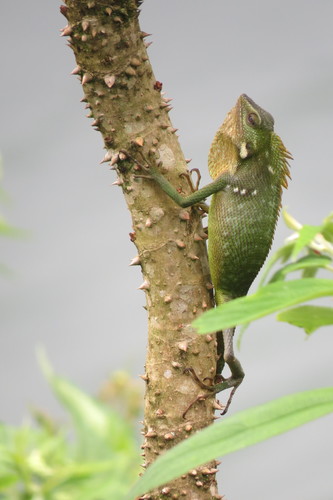
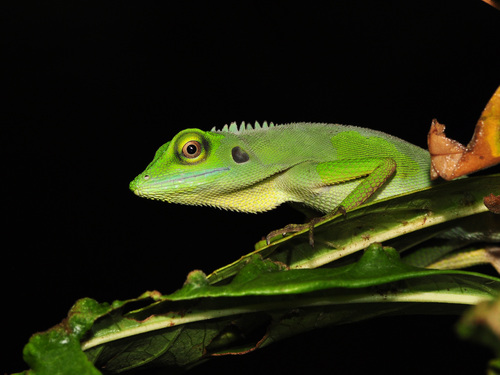
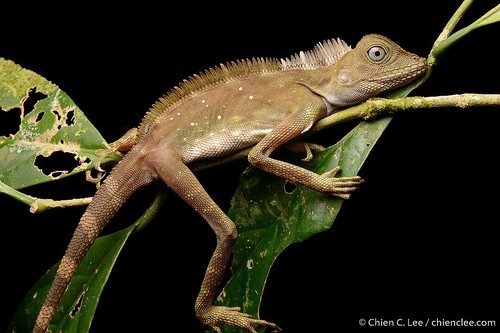
Gonocephalus bornensis (Schlegel, 1851) is a moderately sized lizard, with a maximum snout-vent length (SVL) of 136 mm. Males are generally larger than females: male SVL ranges from 118 to 136 mm, while female SVL ranges from 90 to 130 mm; male tail length ranges from 261 to 310 mm, while female tail length ranges from 215 to 275 mm. This species has a circular border on the supercilium, a rather small tympanum, and a weakly granular dorsum. It also has a prominent lanceolate crest that begins on the neck and ends on the lower back. Its tail is almost cylindrical. Sub-adult males typically have brown, olive, and green dorsal and lateral coloration, and often have dark reticulations across their skin. Adult males are predominantly green, with faint, indistinct reticulation. The iris may be deep brown or light blue. Females have rust red dorsolateral coloration, with oval spots formed by reticulations along the sides of their body. This species is endemic to Borneo. It is common in Mount Kinabalu and Poring Hot Spring in Sabah, and can also be found in Brunei, Sarawak, and Kalimantan. Gonocephalus bornensis inhabits primary and secondary rainforests, at elevations up to 700 m above sea level. It is arboreal, and typically lives on tree trunks and lianas, most often near streams. Females deposit eggs in small burrows dug into soil. Each clutch contains up to four eggs, each measuring 22 mm in length, and clutches are laid at three-month intervals.