About Gonocarpus tetragynus Labill.
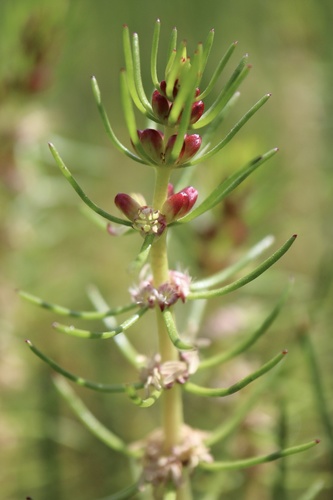
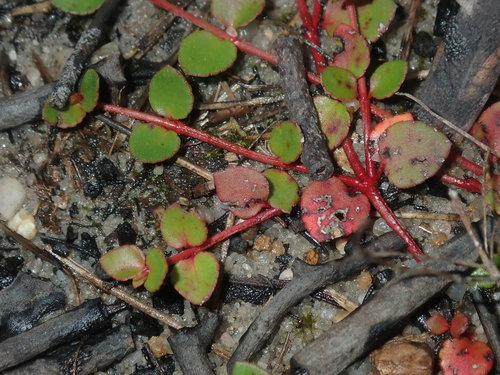
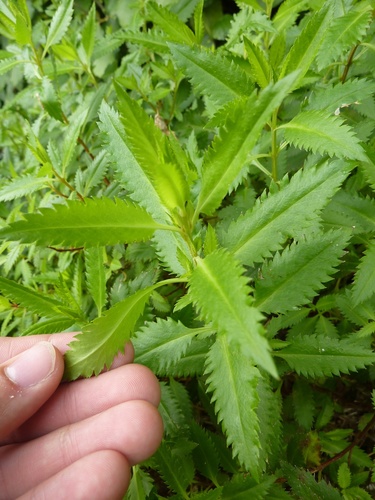
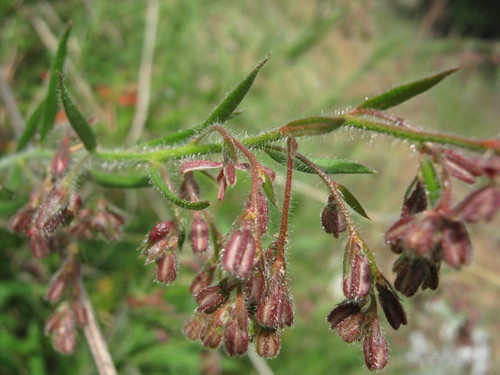
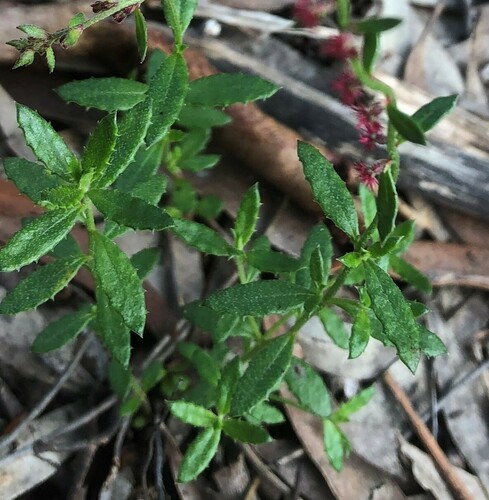
Gonocarpus tetragynus Labill. is a perennial herb that can grow erect or ascending to a height of 15 to 30 cm (5.9 to 11.8 inches). It produces many wiry branching stems that are either smooth or weakly 4-ribbed. Both stems and leaves are covered in white-appressed hairs, which gives the plant a rough texture. Its leaves are decussate and lanceolate, measuring 0.6 to 1.2 cm (0.2 to 0.5 inches) long, with thickened, irregularly toothed, recurved margins, and attach to 0.5 to 1 mm (0.020 to 0.039 inch) long petioles. Bracts of this species are sessile, alternate, and lanceolate, ranging from 2 to 2.5 mm (0.079 to 0.098 inches) long. Bracteoles are membranous, shaped lanceolate to linear-lanceolate, and measure 0.8 to 1.2 mm (0.031 to 0.047 inches) long. Flowers are typically bisexual, though they may become functionally female in occasional individuals when stamens and petals abort. Flowering occurs from spring to summer, between September and February. The inflorescence is a spike holding tiny solitary flowers that are 1 to 3 mm (0.039 to 0.12 inches) across. Like other members of the Haloragaceae family, its flowers are arranged in four whorls. Sepals are deltoid and green, with a prominent basal callus. Petals range from green to red, and are hooded and keeled. This species has eight stamens and an 8-ribbed ovary. Following flowering, it produces a dry, ridged, globular nut fruit that is characteristic of the Haloragaceae family. The nut measures 1 to 1.3 mm (0.039 to 0.051 inches) long, and ranges in color from silver-grey to slate grey. This species is widespread across terrestrial eastern Australia, growing in Queensland, New South Wales, the Australian Capital Territory, Victoria, South Australia, and Tasmania, as well as on Flinders and Clarke islands in the Bass Strait. While widespread overall, it occurs most often in moist to dry soils within dry Eucalyptus forests, shrublands, and heathlands. In Tasmania, it is commonly found on dry stony outcrops. All previously recorded occurrences of this species outside of Australia are the result of misidentification of G. incanus, G. montanus, G. chinensis, and G. philippinensis. While cultivation of Gonocarpus tetragynus is possible, it is not widely grown.