About Gonocarpus micranthus Thunb.
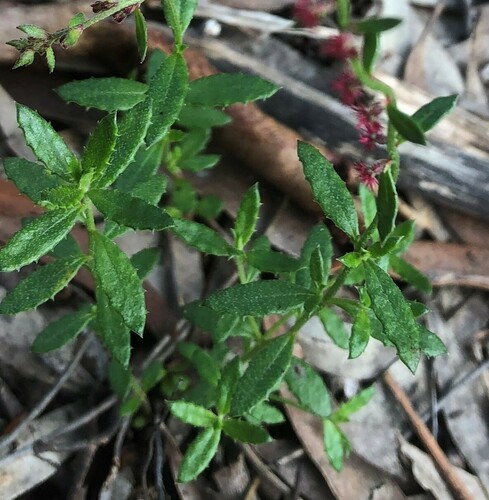
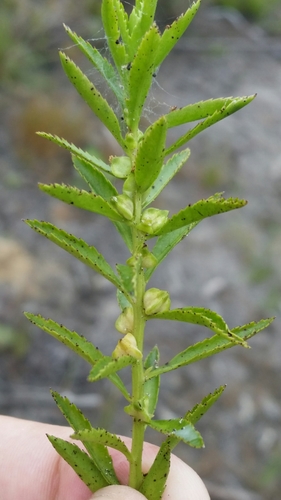
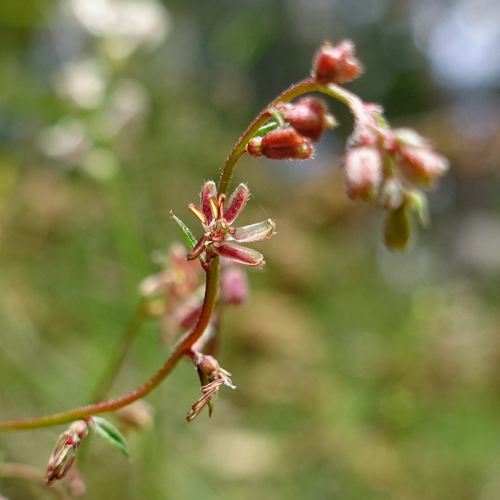
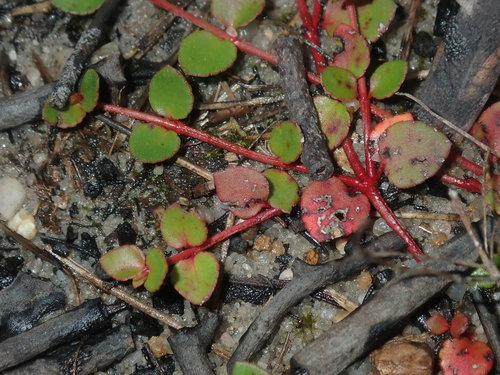
Gonocarpus micranthus Thunb. is a much-branched herb that can be prostrate, ascending, or erect, reaching 5 to 60 cm in height. Its stems root at the nodes, and are smooth, hairless, or rarely have a few scattered hairs, or are sparsely rough-textured. The leaves are opposite and decussate, ranging in shape from orbicular to ovate, with a rounded or cordate base. They are hairless, very variable in size, between 3–15 mm long and 3–11 mm wide. Leaf margins are thickened and bear 8 to 20 small crenate teeth, and the very short petiole is 0.6–2 mm long. Bracts are alternate, lanceolate, 0.5–1 mm long, entire, and deciduous. Bracteoles are orbicular, 0.1–0.2 mm long, either entire or minutely serrate, brown, and deciduous. The inflorescence is typically unbranched, or only branched up to the second order. Flowers hang from short 0.1–0.3 mm long pedicels, and have reddish petals 0.8–1.5 mm long. The fruit is obovoid, up to 1 mm long, smooth, marked with 8 ribs, and colored reddish to grey. Two structurally and distributionally distinct subspecies are currently recognized. Gonocarpus micranthus subsp. micranthus is prostrate to ascending, usually less than 20 cm high. It has narrow inflorescences that are unbranched or branched up to the second order and ascending, and its leaves are predominantly less than 8 mm long. This subspecies is widespread across its range. Gonocarpus micranthus subsp. ramosissimus is erect, growing between 25–60 cm in height. It has diffuse inflorescences that spread to the third or fourth order, with final inflorescence branches that are almost horizontal. Most of its leaves are longer than 8 mm, and this subspecies has a more restricted distribution. Gonocarpus micranthus is distributed across Australia from the Fleurieu Peninsula in South Australia, through Victoria, Tasmania, New South Wales, and Queensland. It also occurs in New Zealand, New Guinea, Southeast Asia, Japan, and the Himalayas. Subspecies ramosissimus is restricted to coastal regions of Australia’s east coast states, with a number of specimens also recorded in southwestern Western Australia. In the northern part of its range, it is limited to alpine to subalpine areas, and descends to sea level in more southern regions. This species grows in heath and wet swampy areas, and extends into open eucalypt forest on damp sandy soils. In Tasmania, it grows on wet peat soils from sea level up to alpine areas.