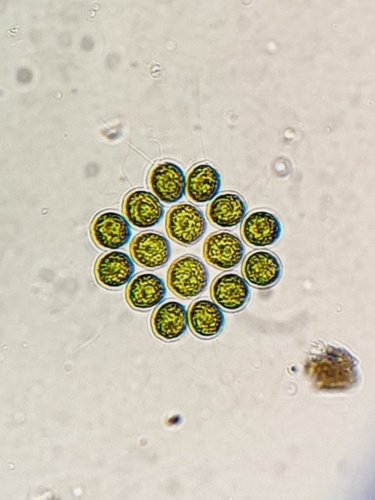
About Gonium pectorale O.F.Müll.
Gonium pectorale O.F.Müll. is a colonial flagellate organism. Colonies are 70–100 μm wide, and typically hold 16 cells, though they sometimes have 8 or 32 cells instead. The standard 16-celled form is organized with four cells at the center and 12 cells along the periphery, with all cells’ flagella pointing outward. Individual cells are nearly spherical or weakly pear-shaped, reaching up to 18 μm wide. Each cell contains a single cup-shaped chloroplast that holds one or two basal pyrenoids, plus an eyespot at the anterior end. Every cell also has two equal-sized flagella. This species is similar to other members of the genus Gonium, particularly in its 16-celled form. Eight-celled colonies of Gonium pectorale almost always follow a zig-zag arrangement with two cells per row. This distinguishes it from related species: the similar Gonium viridistellatum forms eight-celled colonies with seven peripheral cells and one central cell, while Gonium maiaprilis produces eight-celled colonies in a range of different arrangements. Gonium pectorale occurs in freshwater habitats, most often in nutrient-rich lakes, rivers, ditches, and ponds, and it is most common during the spring. It can reproduce both asexually and sexually. For asexual reproduction, the protoplasm of a parent cell divides repeatedly until it forms a new, miniature colony. Sexual reproduction in this species is isogamous: every cell in a colony develops into a gamete. Gametes make contact with each other via their flagella, and form a cytoplasmic bridge before they fuse to create a zygote. The zygote has a thick, smooth cell wall. When the zygote germinates, it first forms four cells, which then undergo successive divisions to ultimately develop into a mature 16-celled colony. There are two reproductively isolated clades within Gonium pectorale: Clade A is distributed across the world, while Clade B is found only in the Southern Hemisphere.

