About Gonionemus vertens A.Agassiz, 1862
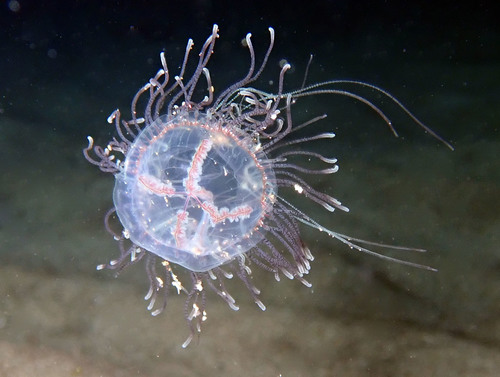
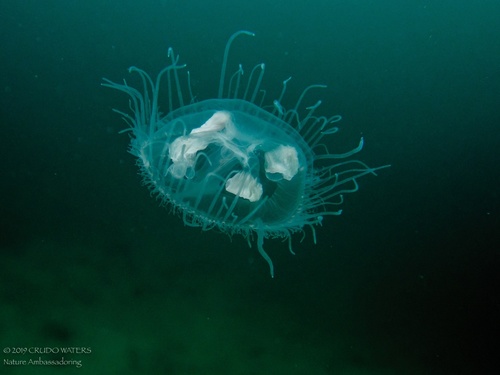
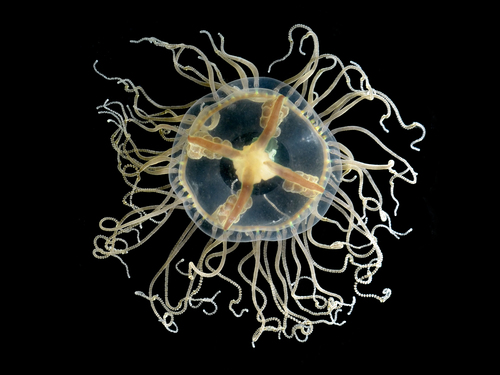
Gonionemus vertens, commonly called the clinging jellyfish, typically has a transparent bell lined with 60–80 tentacles; exceptionally, this number may reach 100–110. Female individuals have distinctly colored orange, red, or violet gonads, while male gonads are yellow-brown. The gonads hang from four radial canals, and appear arranged perpendicularly when viewed from above. A tan-colored manubrium hangs downward from the center of the bell. The bell of this medusa only reaches 1–3 cm (0.4–1.2 in) in diameter, with exceptional specimens growing up to 4 cm (1.6 in). When fully extended, a single tentacle can be twice the diameter of the bell. Medusae of this species reproduce sexually, releasing tens of thousands of eggs and sperm into the sea. Fertilized gametes develop into planula larvae, which eventually attach to algae, rocks, or shells on the seabed to become tiny polyps that grow no larger than 1–2 mm (0.04–0.08 in). Polyps can reproduce asexually by budding, splitting to form new individual polyps. Transformation from polyp to tiny initial medusae, which measure only 1.5 mm (0.06 in) when they first form, typically occurs when water temperatures rise above 17–18 °C (63–64 °F). Because of this temperature trigger, medusae follow an annual life cycle pattern, first appearing in spring or later depending on local water temperatures, and sometimes forming large, sudden population blooms. The free-swimming medusa stage generally lasts no more than three months, but the species can survive for multiple years in the polyp stage. During the day, medusae use adhesive patches on their tentacles to attach to various surfaces, especially seagrass, which gives the species its common name of clinging jellyfish. While G. vertens may catch prey while attached to surfaces during the day, it feeds mostly at night while swimming in open water. Its diet consists of zooplankton organisms such as fish larvae and tiny crustaceans. Gonionemus vertens is a marine and brackish water species found in shallow coastal waters of the north Pacific region, though there is significant uncertainty about its exact native distribution. Its native range is confirmed to include the northwest Pacific from the Russian Far East to Japan. Some authorities also include areas as far south as Vietnam, and the northeast Pacific from the Aleutian Islands to Puget Sound (its type locality) in the native range, while others classify populations in these areas as non-native introductions. The northwest Atlantic population off the coasts of Maine and Massachusetts may be native, but most experts consider it a non-native introduction. In the northwest Atlantic, occasional records of the species extend as far south as New Jersey. Regardless of its exact native range, G. vertens' small size and persistent polyp stage have allowed it to spread to many regions worldwide where it is confirmed to be non-native, where it has become an invasive species. In Europe, where it is non-native, it has been found locally in the Mediterranean Sea and along the Atlantic coast from Portugal to Norway and Sweden. Other confirmed non-native records include northern and southern California, the Dry Tortugas in Florida, and near Mar del Plata in Argentina; the Argentinian site is the only known location of the species in the Southern Hemisphere.