About Gonimbrasia belina Westwood, 1849
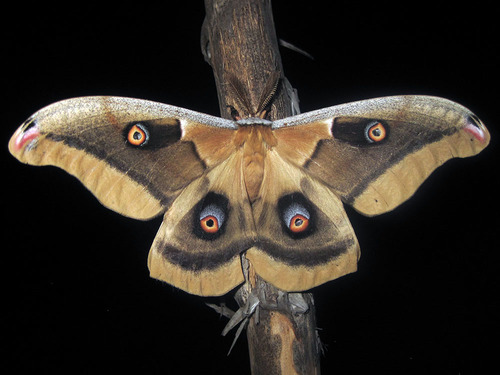
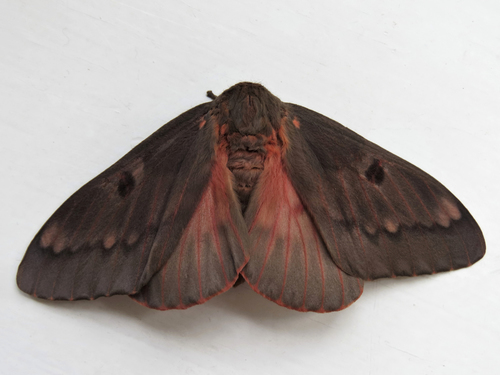
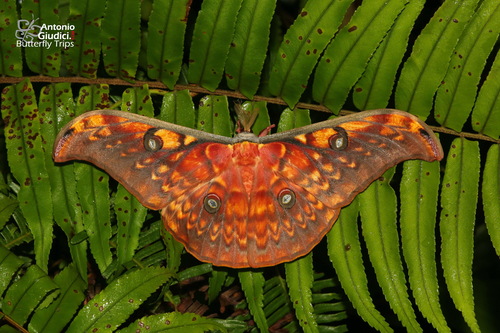
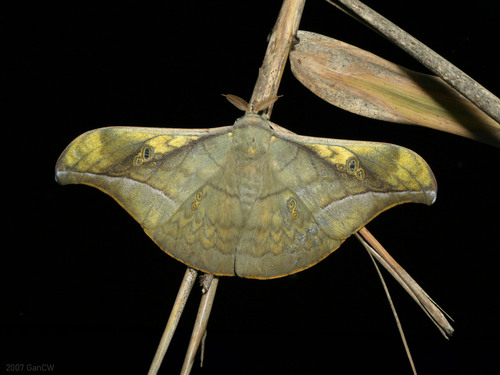
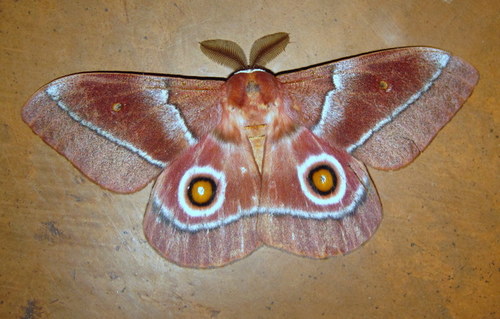
This species has the scientific name Gonimbrasia belina Westwood, 1849. For identification, adult moths are large with a 120 mm wingspan. Their wing color ranges from fawn through shades of green and brown to red, with two black and white bands that isolate the eyespots. Each hindwing has an orange eyespot. Male moths have feathery antennae, which they use to locate a mate. Larvae are black, speckled with round scales, marked with indistinct alternating whitish green and yellow bands, and have short black or reddish spines covered in fine white hairs. This species is widespread and very common in semi-desert, bushveld, and grassland habitats. The life cycle of this species, commonly known as the mopane worm, begins when larvae hatch in summer, after which they feed on nearby foliage. As larvae grow, they moult four times across five larval stages; mopane worms are considered most desirable for harvesting after the fourth moult. If a larva is not harvested after its fourth moult, it burrows underground to pupate, undergoing complete transformation into an adult moth during this stage. Pupation occurs over winter, lasting 6 to 7 months, and adult moths emerge at the start of summer, in November or December. Adult moths live only three to four days, spending this time mating and laying eggs. Mopane worms are harvested from the wild by hand-picking, most often done by women and children. In open bush, wild caterpillars are not considered to belong to any landowner even if one exists, but permission from the local resident must be sought to harvest around a house. Chavanduka documents that women in Zimbabwe tie a piece of bark to specific trees to claim ownership of the caterpillars there, or move young caterpillars to trees closer to their homes. After picking a caterpillar, harvesters pinch its tail end to rupture its internal organs. They then squeeze the caterpillar like a tube of toothpaste or lengthwise like a concertina, and whip it to expel the slimy, green contents of its gut.