About Gonepteryx rhamni (Linnaeus, 1758)
Gonepteryx rhamni, commonly called the common brimstone, is a butterfly belonging to the Pieridae family. It lives across the entire Palearctic zone, and is commonly found throughout Europe, Asia, and North Africa. Across most of its range, it is the only species in its genus, so it is often referred to simply as brimstone in local areas. Its wingspan measures 60–74 mm, which is equal to 2.4–2.9 inches. It should not be confused with the brimstone moth, Opisthograptis luteolata.
Brimstone larvae depend on two buckthorn plant species as host plants, and this dependency shapes the butterfly’s geographic distribution, since these host plants are commonly found in wetlands. Adult common brimstones move to woodland areas to overwinter for seven months. When their host plants finish growing in spring, they return to wetlands to breed and lay eggs. Both larvae and adult common brimstones have protective coloration and behaviour that reduces how easily predators can recognize them, lowering their risk of being preyed on.
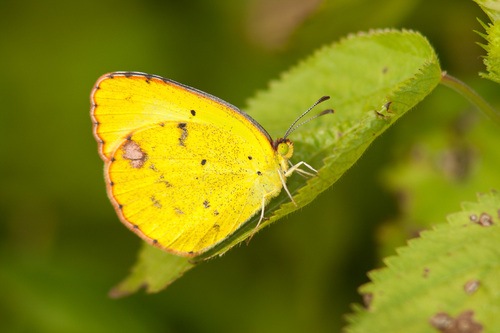
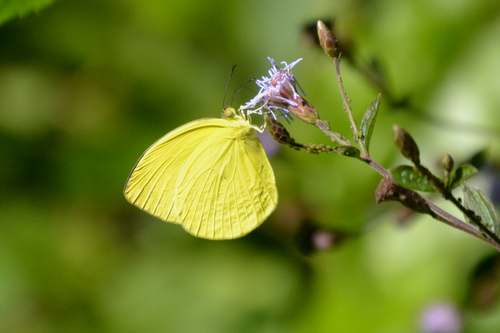
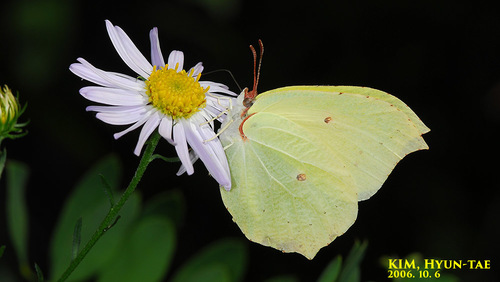
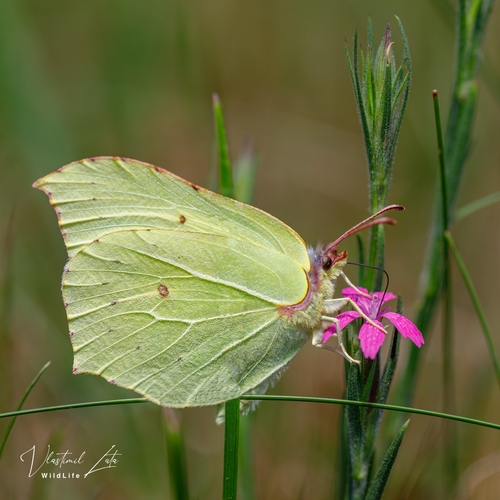
Adult common brimstones have sexual dimorphism in wing coloration: males have yellow wings with iridescence, while females have greenish-white wings with no iridescence. Environmental factors affect this iridescence. The word "butterfly" is thought to originate from this species, which early British naturalists called the "butter-coloured fly".
The common brimstone is widespread across the Palearctic, with individuals observed from western Europe all the way to east Asia. The butterfly’s high mobility lets it search broadly for new host plant sites and expand its range. Even though adult brimstones can be found across a larger area than their host plants grow in, their overall range is still limited by the presence of these host plants, due to the requirements of the larval stage.
The common brimstone uses different environments for different stages of its life cycle. It lives in wetlands during mating and breeding season, as wetlands provide ideal oviposition habitat with abundant host plants such as alder buckthorn. The species prefers to lay eggs on young host plants with late bud-bursts; these plants are typically isolated from other nearby plants, and exposed to open space and sunlight. During winter, adult brimstones travel to woodlands to hibernate, which offer ideal overwintering shelter like evergreen foliage and holly. The common brimstone’s appearance very closely matches the leaves of these woodland plants, letting it stay hidden during hibernation. In other seasons, habitat selection is also influenced by the abundance of nectar, which serves as a food source for adult brimstones.
The common brimstone is one of the longest-lived butterflies, with a life expectancy between 10 months and one year. As a result of its hibernation schedule and life cycle, it produces one generation per year. Development from a laid egg to a fully formed adult imago takes approximately 50 days. Most of the adult brimstone’s life is spent in an overwintering state. The species is highly mobile: it feeds and travels to regions suitable for hibernation during late summer and autumn, then returns to regions suitable for mating and egg-laying in spring.