About Goneplax rhomboides (Linnaeus, 1758)
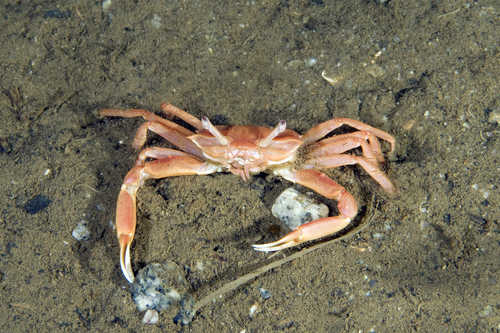
Goneplax rhomboides (Linnaeus, 1758) is a relatively small, distinctive-looking crab. Its carapace can reach up to 3.7 cm (1.5 inches) in diameter. It ranges in color from yellowish-white, to orange, to reddish, to vivid pink. Its carapace is smooth, quadrangular, strongly convex, and much broader than it is long. Its pereiopods are long and slender, with bristles on the margins of the propodus and dactylus. It also has setae on its antennae and mouthparts. Females have short chelipeds, while males have long chelipeds; in males, the merus portion of the claw is considerably longer than the length of the carapace. Its eyes sit on the end of long, retractable eyestalks. G. rhomboides has often been confused with G. clevai, a similar species that shares at least part of its range. G. rhomboides is found in the northeastern Atlantic Ocean and the Mediterranean Sea, ranging from the North Sea to southern Africa, and also along the Indian Ocean coast of South Africa. Waters off Shetland form the northern boundary of its original range. In 2008, marine biologists from the University of Gothenburg discovered an intact G. rhomboides in the stomach of a cod caught off the coast of Bohuslän. A similar discovery a few weeks later at the same location reinforced the conclusion that the species has now moved into Swedish waters. This species inhabits muddy habitats similar to those favored by the Norway lobster, and burrows into inshore muddy sand. Its burrows often interconnect in complex patterns with burrows inhabited by other species of burrowing megafauna, including Callianassa subterranea, Cepola macrophthalma, Lesueurigobius friesii, and Nephrops norvegicus. These multi-species burrow complexes are very common in some localities.

