About Gomphus clavatus (Pers.) Gray
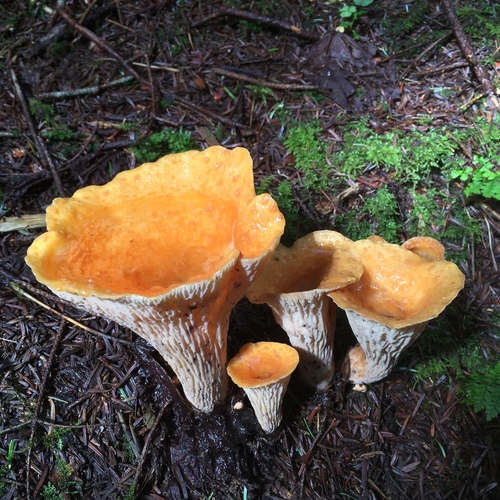
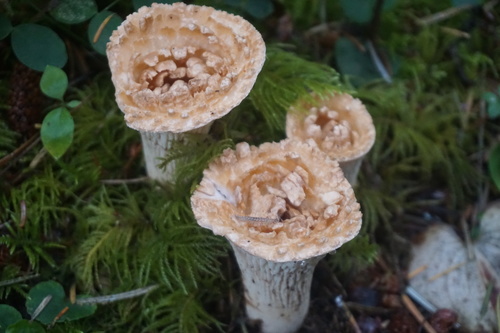
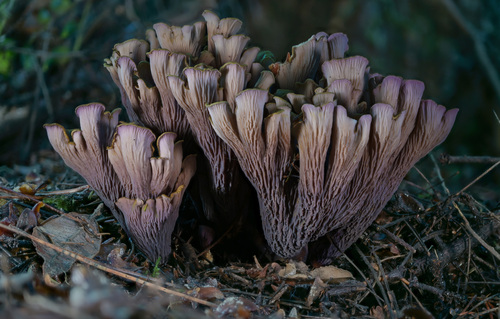
Gomphus clavatus (Pers.) Gray produces club-shaped, single-capped fruit bodies (basidiocarps) when immature. As they mature, they spread out to develop a merismatoid appearance, with multiple vase-shaped caps growing from a shared common stem. Mature fruit bodies reach up to 20 cm (8 in) tall and 15 cm (6 in) wide, with a fan shape and wavy edges. The upper surfaces of fruit bodies are covered with brown microscopic filaments called hyphae. These hyphae form small, distinct patches toward the cap margin, but merge into a continuous, felt-like fine-haired layer (called tomentum) across the center of the cap. The upper cap surface ranges in color from orange-brown to violet, fading to a lighter brown as the mushroom ages. Older specimens often have quite ragged cap margins. The lower spore-bearing surface (the hymenium) is wrinkled, typically with folds and pits, and ranges in color from violet to brown. The solid stem is continuous with the cap, measuring 0.8–3 cm (3⁄8–1+1⁄8 in) wide and 1–10 cm (1⁄2–4 in) tall. It is covered in fine hairs that become coarser (called hispid) toward the base, and it is often compound, with multiple fruit bodies growing from the basal portion. Handled fruit bodies may bruise reddish-brown. The flesh of Gomphus clavatus ranges in color from whitish-pink to lilac or cinnamon-buff. It is thick under the center of the cap and thins out toward the margins. The flesh can be crunchy, though it is softer than the flesh of the chanterelle. Both the taste and odor of Gomphus clavatus are mild. The spore print of this species is yellow to orange-yellow. Its spores are elliptical, wrinkled or slightly warted, and measure 10–14 by 5–7.5 μm. Spores are nonamyloid, meaning they do not produce a color reaction when exposed to iodine in Melzer's reagent. The spore-bearing structures (basidia) are elongated or club-shaped, hyaline (glassy or translucent), and four-spored, with dimensions of 60–90 by 8.5–11.5 μm. G. clavatus does not have cystidia, the sterile cells that grow alongside basidia in many fungal species. Clamp connections are present in the fungal tissue. In terms of habitat and distribution, Gomphus clavatus grows on the ground. Its fruit bodies appear singly, in clusters or clumps, and occasionally even form fairy rings. This species typically grows in coniferous forests, and prefers moist, shady areas with deep leaf litter or rotten wood debris on the ground. It is equally common in both older and younger tree stands. Because its color blends in with the forest floor, its fruit bodies are easily overlooked. It is more common at elevations greater than 2,000 ft (600 m). Gomphus clavatus forms symbiotic mycorrhizal associations with a range of tree species: Abies alba, Abies cephalonica, Abies firma, Abies nephrolepis, Abies religiosa, Picea species, Pinus densiflora, Pseudotsuga menziesii, Tsuga heterophylla, and Fagus sylvatica (beech) in Europe. It has been recorded across multiple continents. In Asia, it has been reported from China, Japan, Korea, Malaysia, Nepal, and Pakistan. In Europe, it has been found in Austria, the Czech Republic, France, Germany, Greece, Italy, Lithuania, Poland, Romania, Russia, Sweden, Switzerland, and Turkey. In North America, it occurs across Canada, Mexico, and the United States. In the U.S., it fruits from October to December on the West Coast and from July to October elsewhere, and is abundant in the Pacific Northwest.