About Gomphosus caeruleus Lacepède, 1801
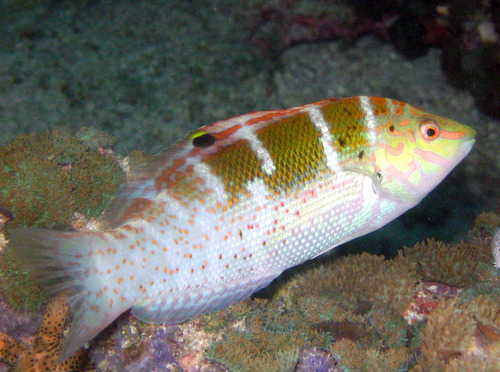
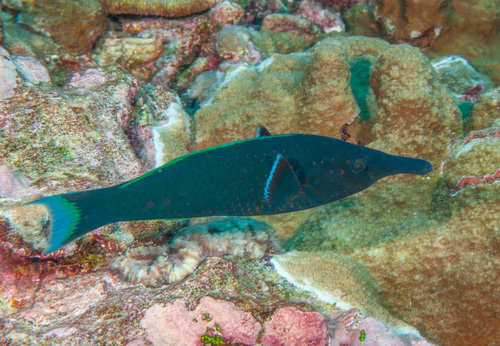
Gomphosus caeruleus, the blue bird wrasse, reaches a maximum length of around 32 centimeters (13 inches), and has a distinctive beak-like snout. This species is sexually dimorphic: mature males are overall dark blue, with a light blue edge along the pectoral fins and lime green dorsal and anal fins. Females have a dark stripe through the eye, plus yellow anal and caudal fins. Juveniles are pale in color, with a dusky streak extending from the snout through the eye and onto the body. Gomphosus caeruleus can be distinguished from the closely related similar species Gomphosus varius (birdnose wrasse) by their differing distributions and consistent color differences. In Gomphosus varius, males have a bright green stripe along the flanks, females lack a yellow tail, and juveniles have a green back, which is not true for Gomphosus caeruleus. The dorsal fin of Gomphosus caeruleus has 8 spines and 13 soft rays, while the anal fin has 3 spines and 11 soft rays. Gomphosus caeruleus was formally described in 1801 by Bernard Germain de Lacépède, in the third volume of his work Histoire naturelle des poissons. The description was based on type specimens collected by Philibert Commerson (1727-1773). No type locality was given in the original publication, but we now know the type locality is Mauritius. This tropical wrasse is native to the Indian Ocean, ranging from East Africa south to Natal, South Africa, and east as far as the Andaman Sea. It inhabits rocky and coral reefs, and is found most often in coral-rich areas of lagoons and seaward reefs, at depths between 1 and 35 meters (3.3 to 114.8 feet).