About Gompholobium huegelii Benth.
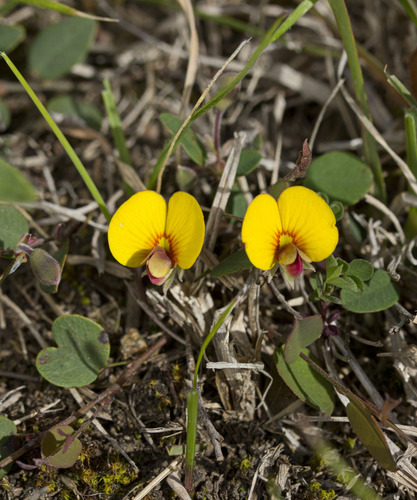
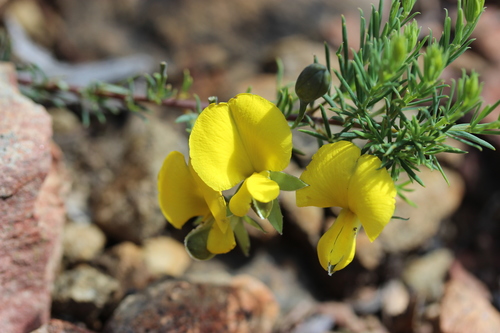
Gompholobium huegelii Benth. is an erect or spreading shrub that is more or less hairless, and typically grows to a maximum height of 1 meter (3 feet 3 inches). Its leaves are trifoliate, made up of linear to lance-shaped leaflets that have their narrower end toward the base. Each leaflet is 5 to 20 millimeters (0.20 to 0.79 inches) long and 0.5 to 2.0 millimeters (0.020 to 0.079 inches) wide, with edges rolled under, and bristly stipules at the base of the leaf. Flowers are arranged singly or in small groups at the ends of branchlets. Each individual flower is 15 to 20 millimeters (0.59 to 0.79 inches) long, on a stalk (pedicel) that can reach up to 15 millimeters (0.59 inches) long. The sepals are up to 10 millimeters (0.39 inches) long. Flower petals are cream-colored to yellow, except for the keel which is yellowish-green. Flowering can occur in most months of the year, with a peak flowering period between September and April. The fruit is an oval pod that grows up to 15 millimeters (0.59 inches) long. This species, commonly called common wedge-pea, grows in heathland and forest habitats. Its distribution ranges from the far southeast of Queensland, through the coast, tablelands and western slopes of New South Wales, into the higher rainfall areas of Victoria, and extends to Tasmania where it is both widespread and common.