About Gomphidius roseus (Fr.) Oudem.
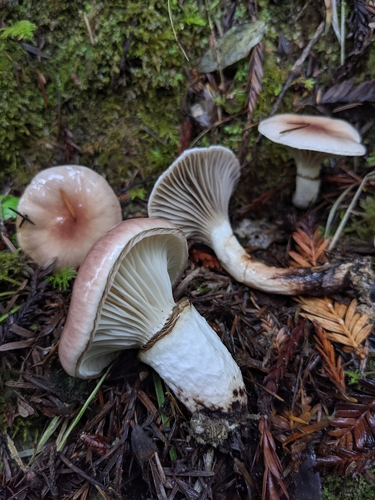
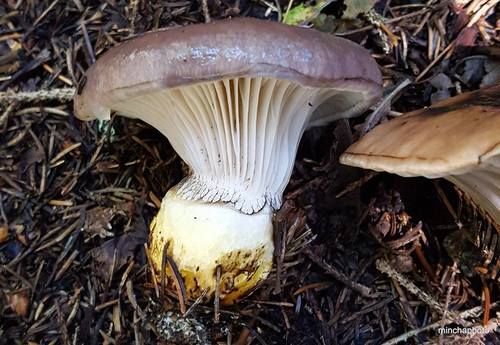
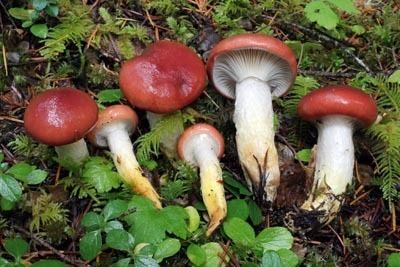
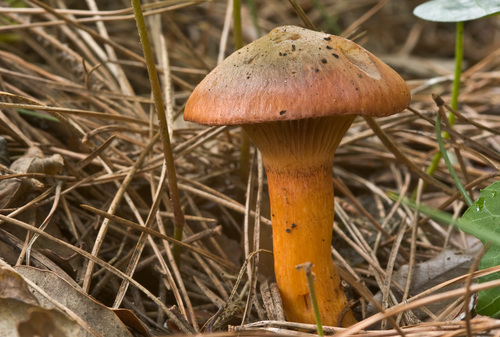
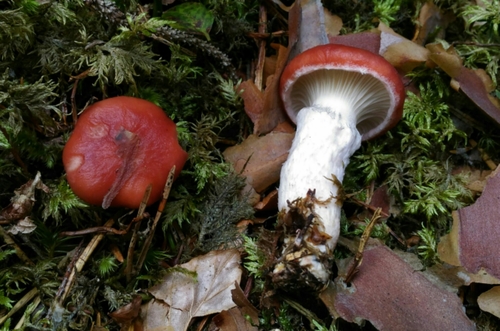
Gomphidius roseus (Fr.) Oudem. has a coral-pink cap that reaches up to 5 cm (2 in) in diameter, and may occasionally grow larger. The cap is initially convex, and flattens as it matures, while developing a more brick-like colour. Like other species in the genus Gomphidius, the cap is often slimy or sticky, and lacks the blackish markings seen on the cap of the related species Gomphidius glutinosus. The stipe measures 2.5–4.5 cm (0.98–1.77 in) in height and 0.4–1 cm in width, and has an indistinct ring. It is white with a pinkish or wine-coloured tint, and often develops a yellow flush at its base. The whitish flesh may also be tinged pink, and has very little taste or smell. The decurrent gills are grey, and the spore print is brownish-black. Gomphidius roseus is an uncommon fungus. It occurs in Europe, including Ukraine, and does not grow in North America. A similar pinkish species, Gomphidius subroseus, occurs in North America. This fungus grows in pine woods, particularly in association with Pinus sylvestris, and is always found associated with Suillus bovinus. It is often hidden in undergrowth, and its fruiting bodies sprout in the autumn. Like other members of the family Gomphidiaceae, Gomphidius roseus was originally thought to be ectomycorrhizal, forming a symbiotic relationship with host trees. Because it is only found growing with Suillus bovinus, and never grows alone, while S. bovinus is often found without G. roseus, it is now thought to be parasitic on the mycelium of S. bovinus. Microscopic examination supports this: G. roseus inserts haustoria into plant root cells, and does not produce significant mycelium of its own.