About Gomphidius oregonensis Peck
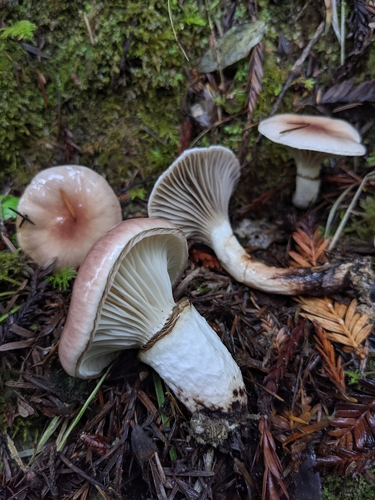
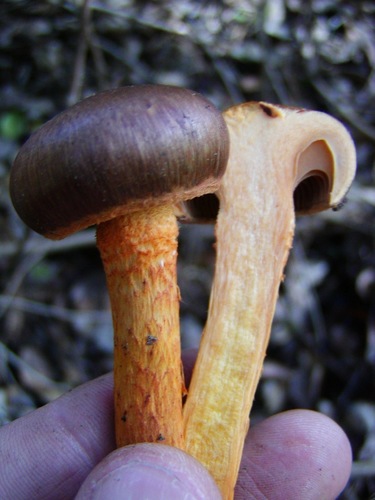
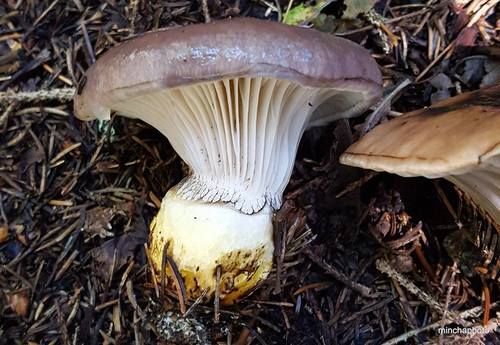
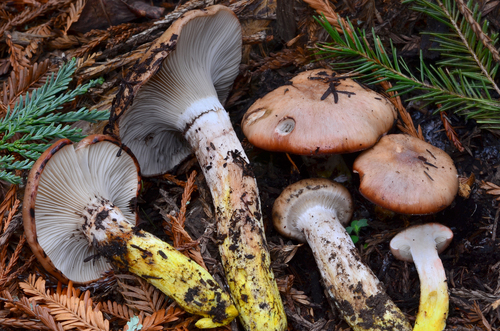
The cap of Gomphidius oregonensis is initially convex and nearly peg-shaped, growing to 2–15 centimetres (3⁄4–6 in) wide. Its surface is smooth and slimy when damp, and its color ranges from whitish to dull pinkish or the color of salmon flesh when young. As the mushroom matures, the cap flattens, sometimes becoming depressed, and changes color to purplish to reddish-brown. The flesh is soft, and colored white or grayish. The gills are decurrent, fairly even, closely spaced, and have a somewhat waxy appearance. They start out white to grayish, and turn black as they ripen. The stalk can reach up to 15 cm long and 1–5 cm thick; its diameter may be consistent from top to bottom, or tapered, or swollen at the base. The color is whitish on the upper portion above the veil, and bright yellow below the veil. The veil is whitish with a thread-like texture, and lies hidden under a layer of slime. The veil fades as it approaches the stalk, where it forms a slimy, almost hairy ring. This ring often turns black as the mushroom ages and spores begin to release. The spores are smooth, spindle-shaped and elliptical, each measuring 10–14 μm long, making this species the smallest-spored in the genus Gomphidius. The spore print is dark gray to black. Gomphidius oregonensis occurs in western North America from October to December, and is most common on the Pacific Coast. It grows on the ground under conifers, particularly Douglas-fir. Mushrooms can grow either solitary or in clusters, and often form colonies alongside G. glutinosus, as well as frequently growing with species from the genus Suillus. It is likely parasitic to Suillus caerulescens, and may also be parasitic to S. ponderosus.