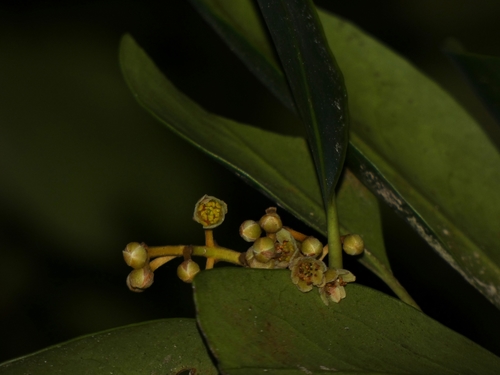
About Gomortega keule (Molina) Gunckel
Gomortega keule is an evergreen, aromatic tree species. Its bark is gray with shallow longitudinal fissures, and its branches are quadrangular. Nodes on stems are unilacunar, with two leaf traces. Leaves are petiolate, simple, entire, obovate to lanceolate, and coriaceous. The fruit of Gomortega keule is an edible yellow drupe that may be uni- or tri-locular. Fruits are 34 to 45 millimetres (1.3 to 1.8 inches) in diameter, with a sweet, pleasant-tasting fleshy mesocarp and a stony endocarp. Most fruits contain 1 seed, and occasionally 2. Seeds have abundant oily endosperm and a large dicotyledonous embryo. Gomortega keule fruits are harvested to make a type of marmalade. The haploid chromosome number for this species is n = 21, and the diploid number is 2n = 42. This species grows only within a very narrow coastal habitat range in Central Chile, where it occurs in the Maulino forest and parts of the Chilean matorral. It is a characteristic tree species of the Maulino forest, growing alongside Nothofagus glauca, Nothofagus × leoni, and Nothofagus alessandrii. Gomortega keule is threatened by habitat loss: most of the Maulino forest has been cleared for agriculture and for plantations of Pinus radiata and Eucalyptus globulus. The species' remaining habitat is fragmented, with isolated populations. It has also been impacted by fires, including the 2017 Chile wildfires. Some populations of the species are protected within Los Queules National Reserve and Los Ruiles National Reserve.

