About Goeppertia roseopicta (Linden ex Lem.) Borchs. & S.Suárez
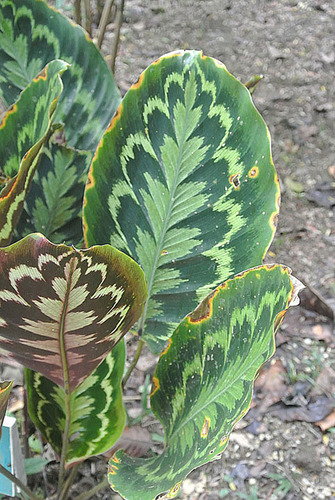
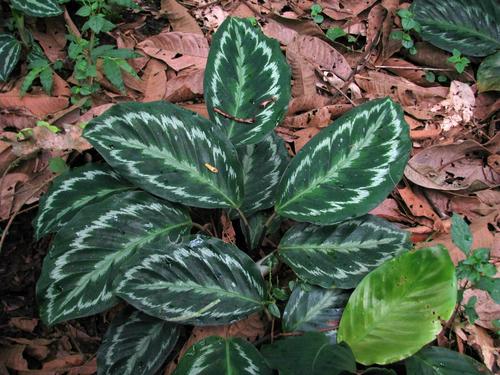
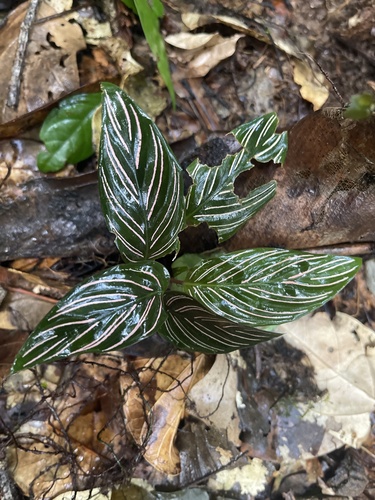
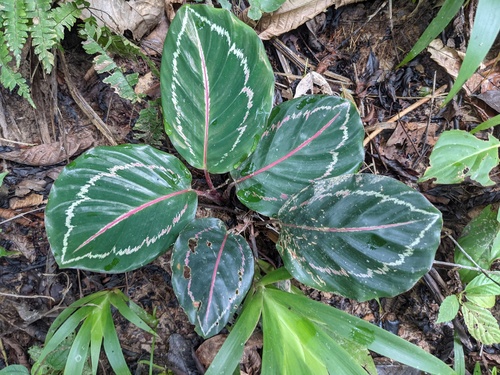
Goeppertia roseopicta is a species of flowering plant in the Marantaceae family, the family of arrowroots and prayer plants, and it is native to the Amazonian basin of northwestern Brazil. It is commonly sold as a houseplant under its former generic name and synonym, Calathea roseopicta. It is an evergreen, clump-forming perennial that grows to 50 cm (20 in) tall, and looks very similar to the related species Goeppertia makoyana. The natural wild-type form of G. roseopicta has papery, ovate leaves in a pastel seafoam green shade, with dark green edging along the leaf outline, and darker streaks painted horizontally out from the leaf midribs. Like other species in its genus and family, G. roseopicta has dark reddish-purplish undersides to its foliage. This trait is an evolutionary adaptation to growing in low-shade forest floor environments, where sufficient light reflection is needed for photosynthesis. Some commercial varieties and cultivars sold in the plant trade have very dark green to blackish or purple-mauve leaves marked with various shades of pink, red, and white, often with little to no visible green coloring. Common cultivated varieties include 'Dottie', 'Rosy', and 'Royale', among others. G. roseopicta is a tender plant that requires a minimum temperature of 16 °C (61 °F). In temperate regions, it is grown indoors as a houseplant. It needs a constant temperature between 18–24 °C (64–75 °F), consistently high humidity, and bright indirect light. As a houseplant, this species has received the Royal Horticultural Society's Award of Garden Merit. The Bora people use this plant for medicinal purposes.