About Gobiomorphus coxii (Krefft, 1864)
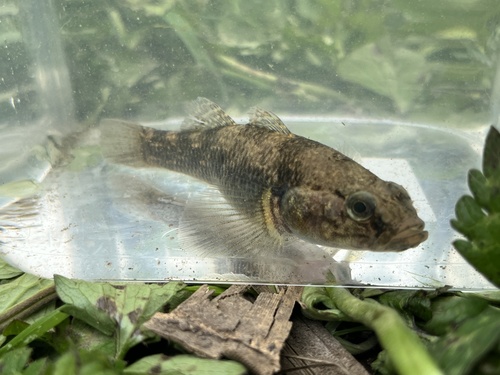
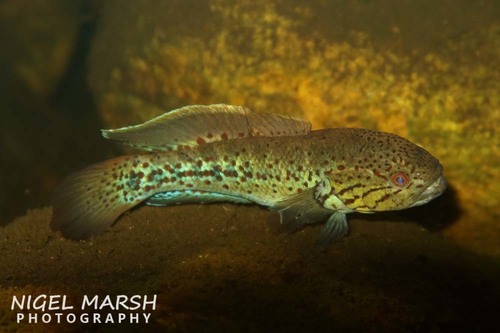
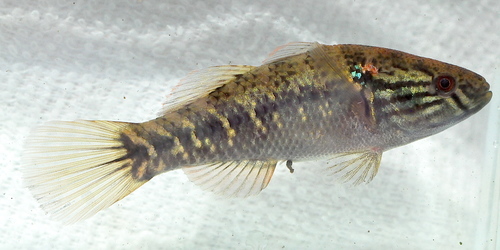
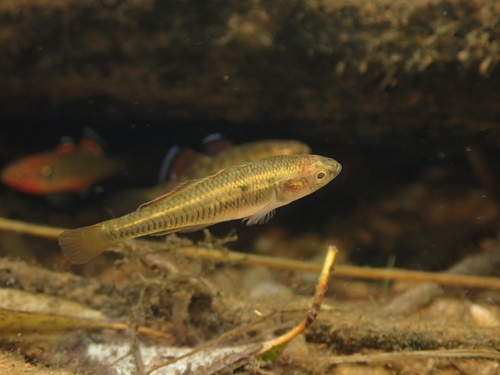
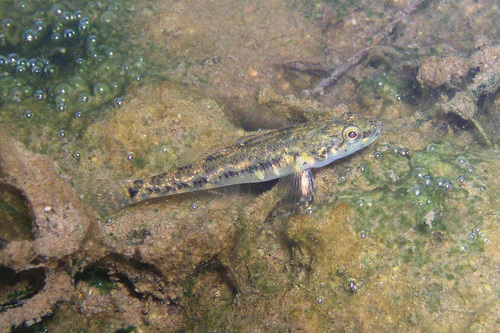
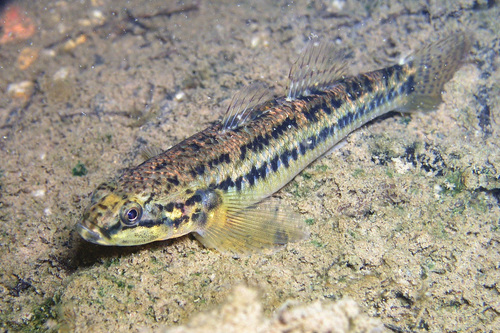
Gobiomorphus coxii (Krefft, 1864) has a dark brown to greenish-brown coloration on its back and flanks, which fades to pale brown or cream on its underside. The scales on its lower flanks are mottled with blue, gold, and yellow, and it has a single black spot above the base of the pectoral fin. Juveniles have a series of elongated blotches on their flanks that merge as they mature to form a wide, dusky mid-lateral stripe. The head is dark brown, with the lower jaw and throat often colored black, and two indistinct dark stripes that radiate from the rear of the eye orbit across the operculum. Its fins range from colorless to blackish-grey; the dorsal fins have between one and three dark stripes set against a yellow or orange background. The fin margins are frequently yellow, and the caudal fin is marked with many dark spots arranged in irregular bands. The body of Gobiomorphus coxii is nearly cylindrical and tapers toward the tail. It has a large head with a blunt, round snout, and quite small eyes positioned high on the head. The mouth is relatively large, oblique, and angled upward, with the lips ending just below the front portion of the eyes. The jaws are lined with bands of fine, pointed teeth. Lines of papillae are present on the cheek and operculum; these papillae also occur around the preopercular margin, and on each side of the snout extending to above the eye. There are 3 to 5 large pores on the preopercular margin. This species has two dorsal fins: the first, anterior dorsal fin is rounded with notches between its six spines, while the second, posterior dorsal fin is taller and slightly longer. The anal fin sits below the second dorsal fin, and is smaller and rounder. The caudal fin is quite large and truncated, the pectoral fins are also large and rounded, and the rather long, pointed pelvic fins are located on the thorax. Males reach a maximum standard length of 19 centimeters (7.5 in), and are more commonly 15 centimeters (5.9 in); females grow larger than males. Gobiomorphus coxii is endemic to eastern Australia, ranging from southern Queensland to Gippsland. It is also found in the Swan River in Western Australia, where it is thought to be an introduced species. This species lives in coastal and inland freshwaters up to around 700 meters (2,300 ft) in altitude, and is normally found in upland streams with reasonably fast currents, including in rapids.