About Gobio gobio (Linnaeus, 1758)
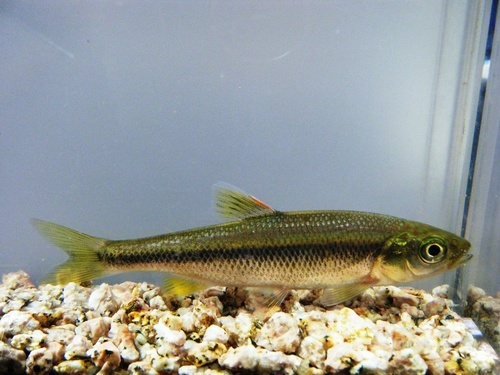
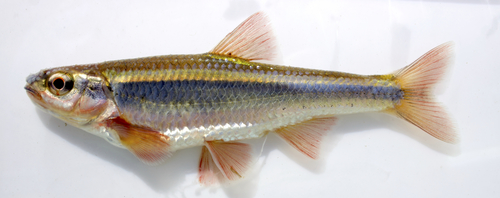
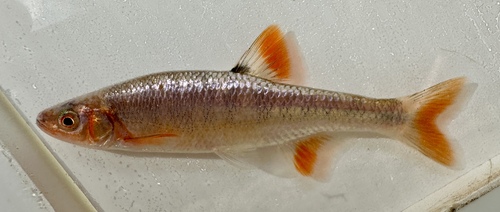
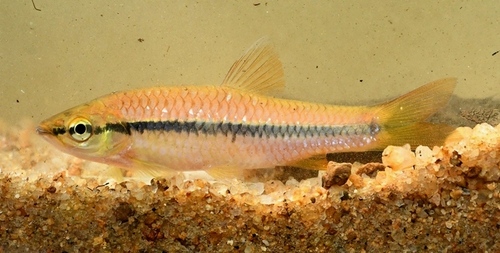
Gobio gobio, commonly called gudgeon, has a long, slender, rounded body. It is usually 9–13 cm (3.5–5.1 in) long, and can reach a maximum length of 21 cm (8.3 in). Its dorsal and anal fins are short, and lack serrated rays. A single labial barbel grows at each corner of its mouth. It has two rows of pharyngeal teeth, which are conical and slightly curved at the tip. The head is wide and flattened, with a fairly blunt snout, and the lower jaw is shorter than the upper jaw. It has relatively large scales, with 40 to 45 scales arranged along the lateral line. Its swim bladder is large. Its body is usually greenish brown on the upper side and silvery on the sides, with a row of six to twelve faint dark blotches running along the flank. The underside is white. Its pectoral, ventral, and anal fins are grayish-white with a brownish tinge, while the dorsal and caudal fins are pale brown with darker spots. The gudgeon occurs in freshwater systems that drain into the eastern Atlantic Ocean, North Sea, and Baltic Sea basins. This range includes the Loire drainage and drainages further east, eastern Great Britain, Rhône drainages, the upper Danube, the middle and upper Dniestr, and the Bug and Dniepr drainages in the Black Sea basin. It is unclear how far the species' range extends into Asia. It typically inhabits lakes, rivers, and streams of all sizes that have sandy or gravelly bottoms.