About Gobiesox strumosus Cope, 1870
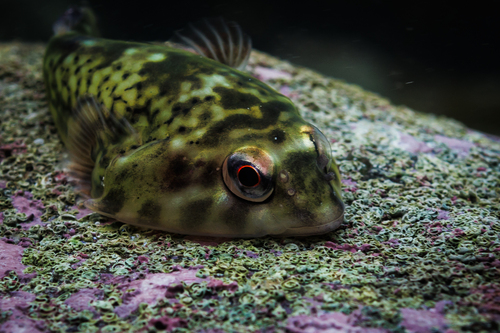
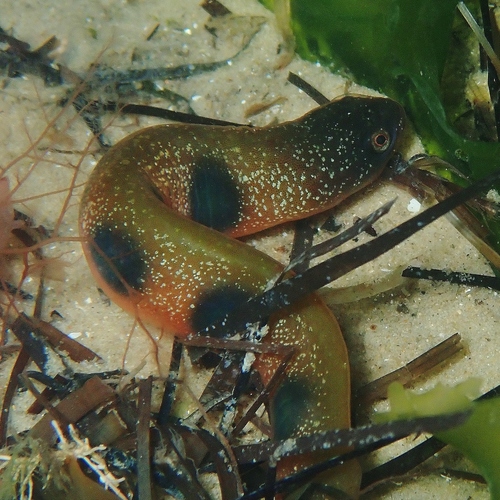
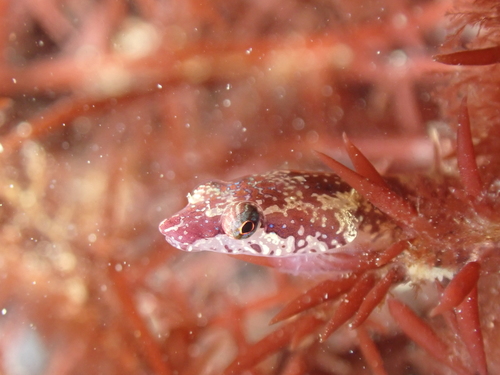
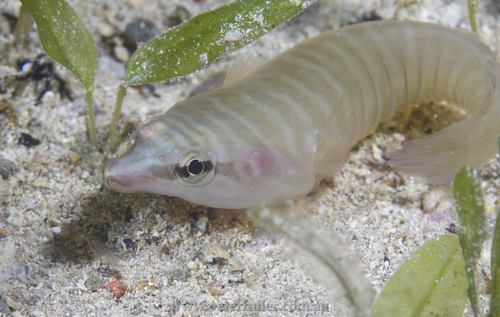
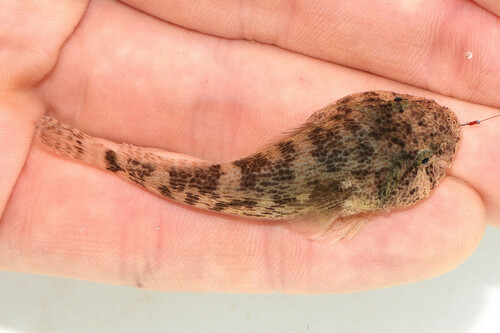
Gobiesox strumosus Cope, 1870, commonly called the skilletfish, has a frying pan-shaped body that reaches a maximum length of around 3 inches. Its body is compressed dorsoventrally, and the head is wider than the rest of the body. Small eyes sit on the top of the head, and the species has strong teeth along with fleshy lips. Skilletfish color ranges from pale gray to dark brown, with a mottled pattern. Approximately six faint lines radiate out from each eye, and there is a dark band at the base of the rounded tail fin. Modified pelvic fins form a large suction disc on the underside of the body, and both the dorsal and ventral fins are positioned quite far back along the body. Skilletfish usually live among oyster reefs, but may also occur in eelgrass beds. During warmer months, they stay in shallow nearshore waters up to 1 m deep, and move to deeper waters reaching 33 m deep in winter. They almost always cling to rocks or shells using their suction disc. This species is found in two regions: the Western Atlantic from Bermuda, New Jersey, and the northern Gulf of Mexico (USA) down to southeastern Brazil, where it is absent from the Bahamas; and the Eastern Central Pacific in coastal lagoons and tidal flats of Sonora, Sinaloa, and Nayarit, Mexico. Its overall distribution extends from New York and New Jersey in the north southward to Brazil, and also includes the West Indies and the Gulf of Mexico. For skilletfish, spawning takes place between April and August. Females lay a few hundred sticky, amber-colored eggs into an empty oyster shell, after which males guard the eggs until they hatch. Newly hatched skilletfish measure 2.4–3.4 mm long. They grow approximately 9 mm during development, and reach 40–45 mm in total length by the time of their first reproduction.