About Gobiesox maeandricus (Girard, 1858)
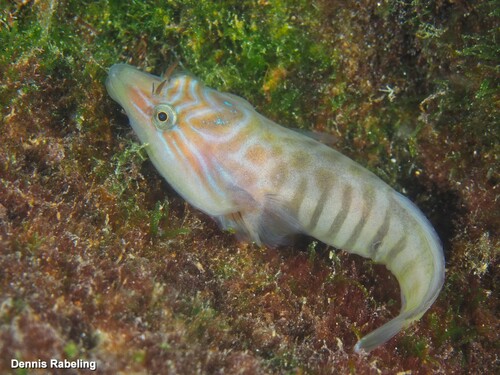
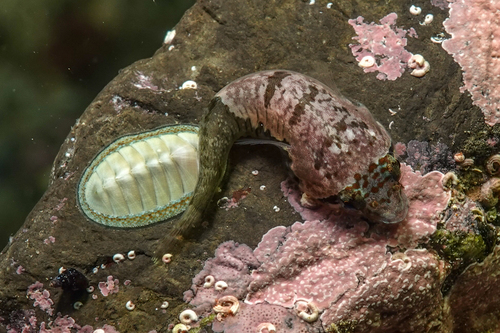
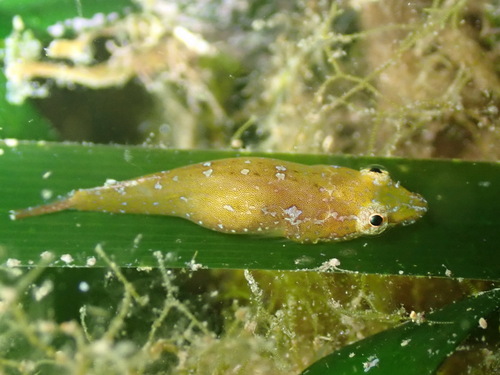
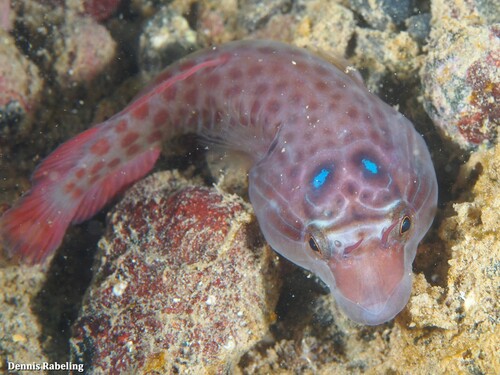
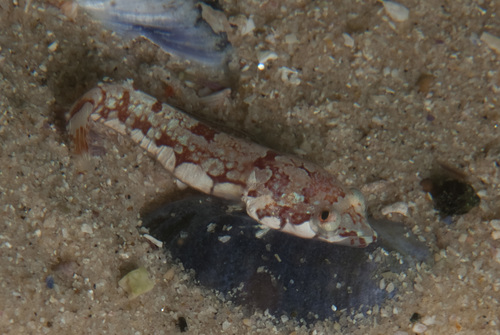
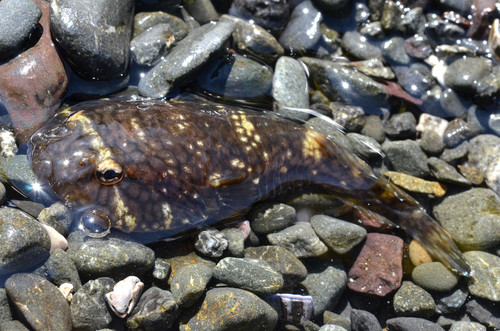
Gobiesox maeandricus, first described by Girard in 1858, has a flattened, elongated body and head, with smooth, slimy, scaleless skin. It can be identified by 12 to 14 soft anal rays, 13 to 16 soft dorsal rays, and a complete lack of spined rays. Its caudal fin is rounded, while its pectoral fins are short and broad, supporting suction and maneuverability. Adult individuals typically reach around 7.6 cm (3 inches) in length, though they can grow as large as 17 cm (6.5 inches). Its body color ranges from brown to reddish tones, and juveniles have distinctive white bars along the dorsal side and the edge of the caudal fin. Morphologically, this species has a reduced swim bladder and no stomach. Like other clingfish, G. maeandricus has modified pelvic and pectoral fins that are fused to form a powerful suction disc, which lets it cling to different surfaces. This adhesive structure sits on the ventral side of the body, and allows the fish to attach to rough substrates and withstand powerful waves. It has specialized epithelial microstructures called epidermal papillae, which are divided into tiny filaments that surround the suction disc. When viewed under a microscope, these filaments are soft, hair-like structures that create friction. When the edges of the suction disc move inward to attach to a surface, the hair-like filaments stop water from leaking underneath the disc. Even in strong currents and heavy wave action, these suction discs can produce an attachment force 80 to 150 times the fish's body weight. Most rocks in the species' habitat are covered with biofilms made up of algae, bacteria, and invertebrates, which improves the clingfish's ability to attach, as it can anchor to this biological layer instead of bare rock. On unfouled rocks, the suction disc may not adhere effectively. The fish can successfully attach to a wide variety of surface types, from slippery to non-slippery and from smooth to rough. Body size also affects adhesive performance: larger fish have a greater surface area for friction, leading to stronger adhesion. Researchers study the suction abilities of this clingfish to improve adhesive technologies. This species lives in the rocky intertidal zone of the eastern Pacific Ocean. Its range runs along the coasts of Canada, the United States, and Mexico, extending from southeastern Alaska down to southern California, and continuing into Baja California. A small number of individuals are also found around Revillagigedo Island in the eastern Pacific. As an intertidal species, G. maeandricus experiences regular environmental changes caused by tides, and it is abundant across its entire native range.