About Gnypetoscincus queenslandiae (De Vis, 1890)
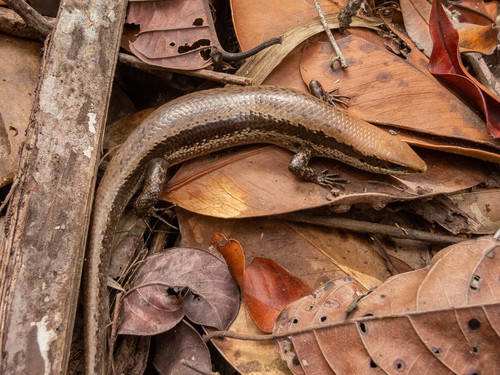
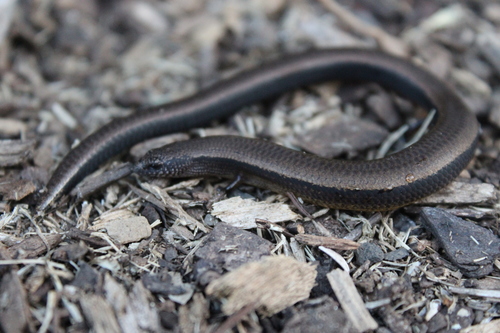
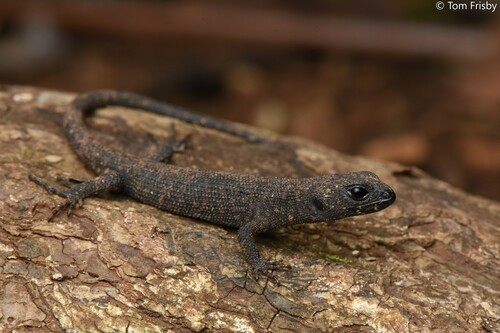
The prickly skink, also called the prickly forest skink, has the scientific name Gnypetoscincus queenslandiae. It is a morphologically and genetically distinct skink species endemic to rainforests in the Wet Tropics of Queensland World Heritage Area, located in north-eastern Australia. Unlike most small skinks that have smooth scales, this species has rough, ridged, and pointed scales. These keeled scales may be an adaptation to its high-rainfall habitat, its microhabitat within rotting logs, or for camouflage while moving through forest leaf-litter. This prickly skink is a habitat specialist, restricted to closed canopy rainforest in the high rainfall Australian Wet Tropics. Its range spans from lowland tropical rainforest to montane forests on nearby hills and tablelands. Within these rainforests, the prickly skink lives among rotting logs and leaf litter. While it can be locally abundant in some areas, it is rarely spotted without active searching. Its rainforest habitat is a well-buffered environment with very low seasonality. This species is ovoviviparous. Even though it lives in an equable climate, its reproduction is seasonal: females give birth to 2 to 5 young between February and April. Individuals reach maturity when they reach a snout-vent length (SVL) of about 50 mm (2.0 in), and grow to a maximum SVL of 85 mm (3.3 in). There are no obvious differences in external morphology or size between females and males. A skeletochronological study indicates that this species reaches maturity at 5 years of age, and has a maximum lifespan of around 10 years. Unlike most skinks, this is a vocal species. Its high-pitched but audible calls have been recorded in the wild and in captivity, produced during handling and during aggressive interactions between females.