About Gnetum edule (Willd.) Blume
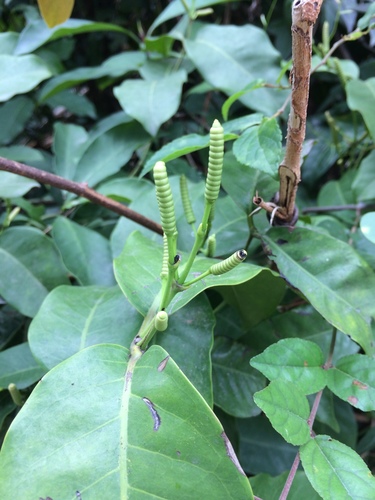
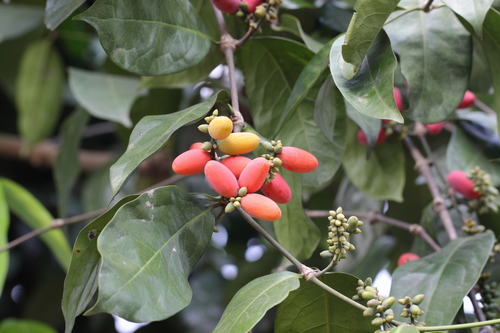
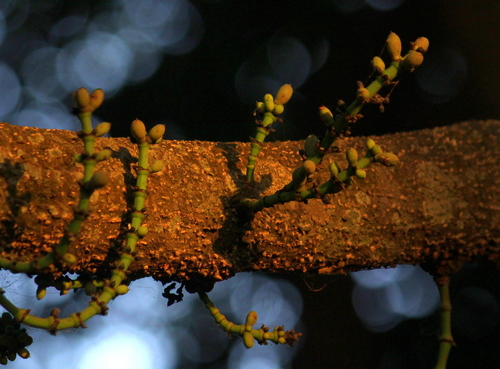
Gnetum edule (Willd.) Blume is an evergreen woody vine. Its stems have swollen nodes. Leaves are opposite, stalked, simple, pinnately veined, with entire margins. Flowers are unisexual, born in whorled, spike-like cones arranged in lax cymes. Male spikes have closely arranged collars that more or less hide the axis, and less often the collars are somewhat laxly arranged. Each male collar holds 20–80 flowers, and often also has a whorl of sterile female flowers; the apical whorl only contains sterile female flowers. Female spikes are solitary or grouped into several within a panicle, and are often cauliflorous. Their involucral collars are widely spaced, with 4–12 flowers per collar. Seeds are drupe-like, enclosed in a red, orange, or yellow fleshy, rarely corky, false seed coat. G. edule is one of 7 Gnetum species found in India. It grows primarily in wet tropical biomes in southwest and southeastern India. It occurs in the Karakoram–West Tibetan Plateau alpine steppe, North Western Ghats montane rain forests, South Deccan Plateau dry deciduous forests, and Malabar Coast moist forests ecoregions, and has also been reported from the Andaman and Nicobar Islands. Like most Gnetum species, G. edule seeds are edible and are usually eaten after roasting. Oil can be produced from the seeds for use as medicine or for burning. In the Kodaikanal region, local people extract oil from G. edule seeds to burn in soil-made lamps. In Chatnoor, local people use G. edule seeds as a fish poison due to the seeds' piscicidal properties.