About Gnathodentex aureolineatus (Lacepède, 1802)
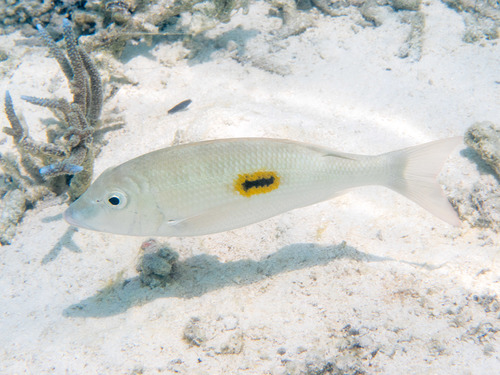
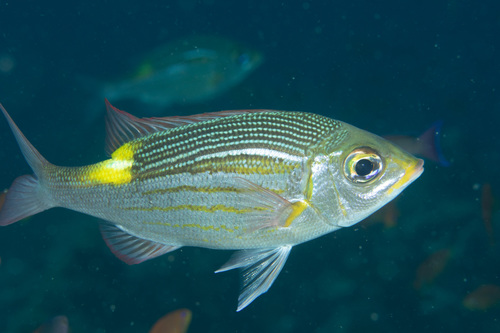
Gnathodentex aureolineatus, commonly called the goldspot seabream, is a medium-sized fish that reaches a maximum total length of 30 centimetres (12 inches), with a more common observed length of 20 centimetres. This species has a laterally compressed body, a pointed snout, and a forked tail. Its base body color is silver-grey, marked with golden horizontal lines along its sides; these golden lines are topped by darker horizontal lines. Its fins have a pinkish tint, a yellow moustache-shaped stripe runs above its upper lip, and yellow markings are present at the junction of the pectoral fins and the body, as well as along the outer edge of the operculum. A key identifying feature of this species is a distinct golden yellow spot on the back, located at the far end of the dorsal fin. Relative to its overall body size, its eyes are quite large. The dorsal fin is made up of 10 spines and 10 soft rays, while the anal fin contains 3 spines and between 8 and 10 soft rays. Gnathodentex aureolineatus occurs in tropical and subtropical waters across the Indo-Pacific region, ranging from the eastern coast of Africa to the islands of the Pacific Ocean, but is not found in Hawaii, the Red Sea, or the Persian Gulf. This species prefers habitats near reefs, on both external and non-external reef slopes.