About Gnathanodon speciosus (Forsskål, 1775)
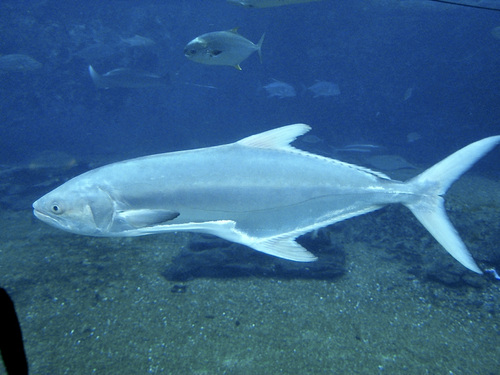
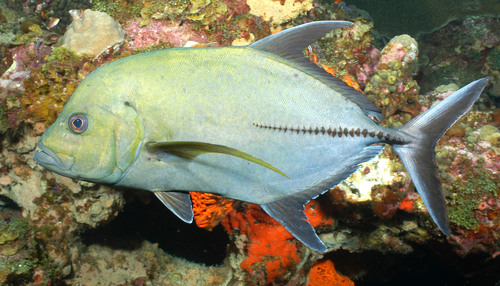
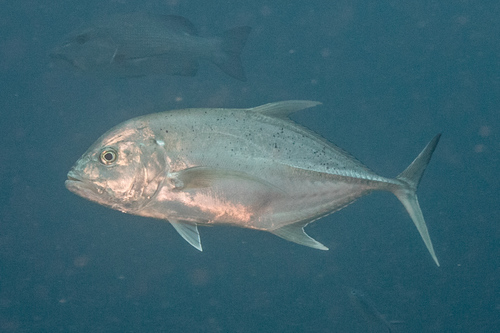
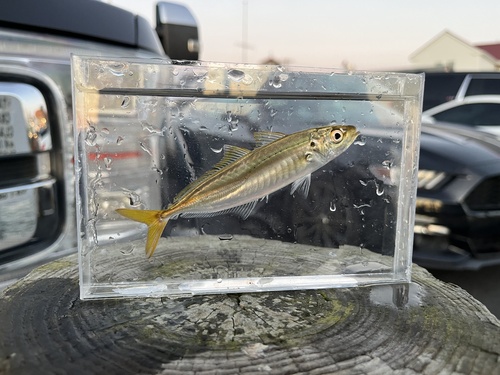
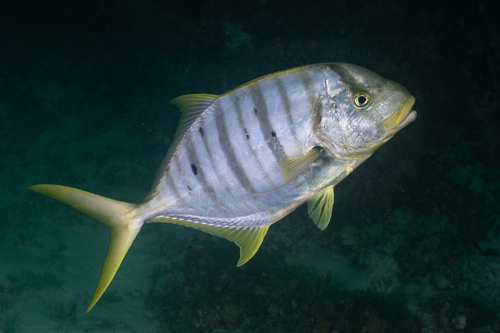
The golden trevally (Gnathanodon speciosus) is a relatively large fish, reaching a maximum recorded size of 120 cm (47 in) in length and 15.0 kg in weight. Like most other trevallies and jacks, it has a compressed, oblong body, where the dorsal profile is slightly more convex than the ventral profile, particularly toward the front of the body. The mouth is a defining feature of this species: it is highly protractile and fleshy. Specimens longer than 90 mm have no teeth on the jaws, vomer, or tongue, while smaller individuals have a series of small villiform teeth in both jaws. The dorsal fin is split into two distinct parts: the first has 7 spines, and the second has 1 spine plus 18 to 20 soft rays. The anal fin has 2 detached spines, followed by 1 spine and 15 to 17 soft rays. The pelvic fin consists of 1 spine and 19 to 20 soft rays. The curved section of the lateral line is moderately arched, holds 62 to 73 scales, and is approximately equal in length to the straight section. The straight section contains 15 to 27 scales and 18 to 25 scutes. The entire breast is covered in scales. The species has 27 to 30 gill rakers and 24 total vertebrae. The golden trevally’s coloration is its most prominent distinguishing feature, which is how it earned its common name. Juveniles are bright golden yellow across their entire body and all fins, with 7 to 11 black vertical crossbars covering the body. These bars generally alternate between broad and narrow widths. The lobes of the caudal fin have dark tips, and there is a prominent black edge on the operculum. As the fish grows, its body becomes more silver to silvery golden, and the vertical crossbars fade or disappear, often replaced by dark blotches. The fins remain yellow, and often have greenish tinges. The dark edge of the operculum also fades with age. The golden trevally is widely distributed across the tropical and subtropical waters of the Indian and Pacific Oceans. In the Indian Ocean, it ranges from South Africa along the entire East African coastline, including the Red Sea and Persian Gulf. Its range extends east along the coastlines of South and Southeast Asia, then south through Indonesia and into northern Australia. It has been recorded on many Indian Ocean islands, including Madagascar, the Seychelles, and the Maldives. In the Pacific Ocean, the species ranges across the Southeast Asian and Indonesian archipelagos, north to mainland China and Japan, and south to eastern Australia and New Zealand. It has been recorded at many central Pacific islands, including Hawaii, and its range extends to Central America, where it occurs from the Gulf of California in the north to Colombia in the south. The golden trevally mostly lives in inshore waters with varying substrates, though it is also known to occur on deeper continental shelf reefs in Australia. In coastal areas, it inhabits rocky and coral reefs, as well as open sand flats where it forages for food. A systematic study in northern Australia found that it is one of the only species to be approximately equally distributed across both reef and soft-bottom habitats. Golden trevally prefer clear water over turbid water, so they are only rarely encountered in low-turbidity estuarine environments. The only recorded exception is the capture of several individuals foraging in a shallow mangrove swamp in Baja California. Adult golden trevally are found either alone or in small schools. Juveniles tend to form larger schools, which often congregate around and follow, or "pilot," larger fish such as groupers, sharks, and even jellyfish. This behavior matches that of the closely related pilot fish, Naucrates ductor. The golden trevally’s maneuverability protects it from its host, and the association in turn protects it from predation by other fish. This behavior has also been observed toward scuba divers: one diver reported a young individual that obsessively positioned itself directly in front of his face plate. The golden trevally is a diurnal, carnivorous forager, and unlike other carangids, it does not normally hunt for individual prey items. It uses its highly protractile mouth to form a tube that sucks prey out of reef and algae-dominated habitats, and filters small organisms out of sandy substrates. When foraging in sand, it takes both sand and any prey into its mouth and filters the mixture through its gill rakers: sand is expelled, while small organisms are trapped and swallowed. The species eats a wide variety of prey, including crustaceans such as shrimp, crabs, and amphipods, as well as molluscs and small fish. Golden trevally found in the Baja California mangrove swamp had fed exclusively on Mugil curema fish, which suggests the species can also actively hunt down fleeing prey. A laboratory study using just four feeding individuals found that one fish would take a "lead" position during feeding, while another would attack other fish in the group, apparently competing for food. A variety of parasites have been recorded from this species, including copepods, flatworms, and a nematode that lives in the fish’s swimbladder. Reproduction of the golden trevally has been studied in both the Indian and Pacific Oceans. In Hawaii, spawning takes place from late February to early October, with a peak spawning period from late April to early September. Five distinct spawning peaks during this period correlate with the first and third quarters of the moon. Spawning occurs from early evening through the night. In the Indian Ocean’s southern Persian Gulf, spawning occurs in April and May, with defined peaks of juvenile recruitment into the local fishery in September and October. The male-to-female sex ratio in this population is 1:1.01, very close to equal. Growth rates were also studied using otoliths in this population, and results show an increased growth rate during the winter, which falls between November and April. Von Bertalanffy growth curves have also been calculated for the species.