About Glyptemys insculpta (Le Conte, 1830)
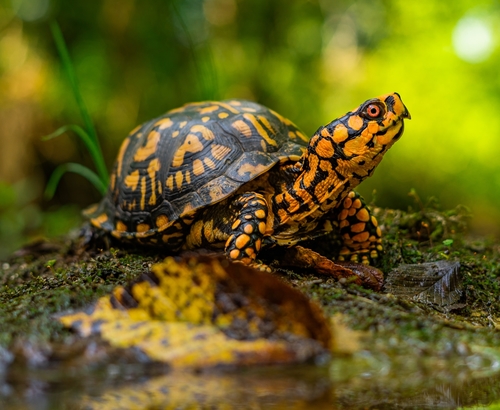
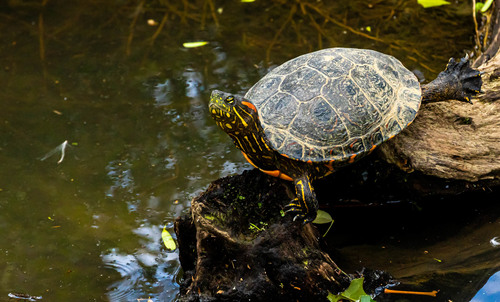
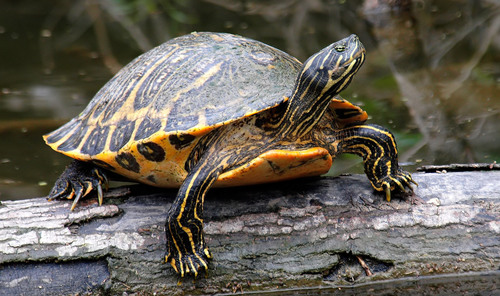
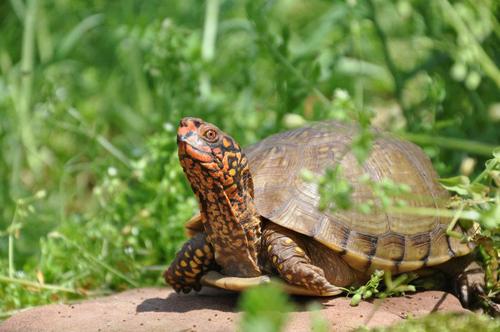
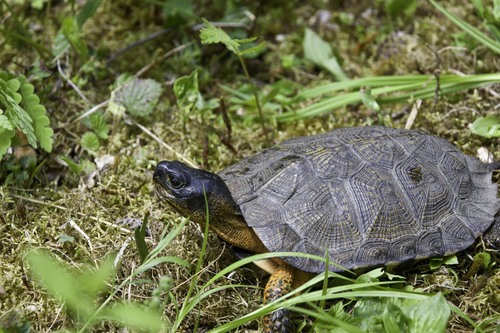
Glyptemys insculpta, commonly called the wood turtle, typically reaches 14 to 20 centimeters (5.5 to 7.9 inches) in straight carapace length, with a maximum recorded length of 23.4 centimeters (9.2 inches). Fully grown adults weigh around 1 kilogram (2.2 pounds), and the species has a karyotype of 50 chromosomes. Its carapace is rough, colored tan, grayish brown, or brown, and features a central keel marked with a pyramidal pattern of ridges and grooves. Larger scutes on the carapace have black or yellow line patterns, and the carapaces of older turtles are typically abraded or worn. The wood turtle's ventral shell, called the plastron, is yellowish with dark patches, and ends in a V-shaped notch at its posterior margin. The top of the head is most often dark gray to solid black, sometimes speckled with yellow spots. The undersides of the neck, chin, and legs range from orange to red; some individuals have faint yellow stripes along the lower jaw, and color vibrancy varies seasonally. Mature males are larger than mature females: males reach a maximum straight carapace length of 23.4 centimeters (9.2 inches), while females reach a maximum of 20.4 centimeters (8.0 inches). Males also have larger claws, a larger head, a concave plastron, a more dome-like carapace, and a longer tail than females. The plastron is flat in females and juvenile turtles, and develops concavity as males age. The posterior marginal scutes of females and juveniles of either sex radiate outward more than those of mature males. The coloration on the neck, chin, and inner legs is more vibrant in males than in females, which have pale yellow coloration in these areas. Hatchlings have a straight carapace length of 2.8 to 3.8 centimeters (1.1 to 1.5 inches). Their plastrons are dull gray to brown, their tails are typically the same length as their carapaces, and their necks and legs lack the bright coloration of adults. Hatchling carapaces are as wide as they are long, and do not have the pyramidal pattern seen in older turtles. The wood turtle shares overlapping habitat with the similar-looking eastern box turtle (Terrapene c. carolina) and Blanding's turtle (Emydoidea blandingii), but unlike the wood turtle, both of these species have hinged plastrons that let them fully close their shells. The diamondback terrapin (Malaclemys terrapin) has a shell that closely resembles the wood turtle's, but it has gray skin and lives in coastal brackish and saltwater marshes. The bog turtle and spotted turtle are also similar in appearance to the wood turtle, but neither has the distinct sculptured carapace surface of the wood turtle. The wood turtle's distribution extends through most New England states and Nova Scotia, west to Michigan, northern Indiana, and Minnesota, and south to Virginia. Its overall distribution is disjunct, with populations often small and isolated; approximately 30% of the total population lives in Canada. The species prefers slow-moving streams with sandy bottoms and heavily vegetated banks. The soft bottoms and muddy shores of these streams are ideal for overwintering, and open-canopy areas bordering streams are used for nesting. From spring to summer, wood turtles occupy open areas including forests, fields, bogs, wet meadows, and beaver ponds. They spend the rest of the year in the streams described above. Population density varies across the wood turtle's range. In the northern part of the range, including Quebec and other areas of Canada, populations are sparse, with an average of 0.44 individuals per hectare (2.5 acres). In the southern part of the range, density ranges widely from 6 to 90 individuals per hectare. Colonies often have more females than males. In the western portion of its range, wood turtles are more aquatic, while in the east they are more terrestrial, especially in summer. Even in the east, they never stay far from water, and enter water every few days. In spring, wood turtles are active during the day, usually between 7:00 a.m. and 7:00 p.m., and are almost always found within several hundred meters of a stream. They prefer to forage in early morning and late afternoon, and bask in sunlight on logs, sandy shores, or banks throughout the season. They spend a considerable amount of time basking to regulate body temperature, with most basking occurring in late morning and late afternoon. After basking, their peak body temperature reaches 37 °C (99 °F). During extreme heat, wood turtles will estivate, resting under vegetation, fallen debris, and in shallow puddles. In summer, the species is largely terrestrial. At night, their average body temperature drops to between 15 and 20 °C (59 and 68 °F), and they rest in small creeks or on nearby land in areas with underbrush or grass. During cold weather, wood turtles spend a larger percentage of their time in water, and are considered aquatic during winter, late fall, and early spring. They hibernate from November through February or March, buried in thick mud at the bottom of small flowing rivers. They may hibernate alone or in large groups, and rarely move during this period, when they are vulnerable to flash floods. They emerge from hibernation in March or sometimes April, when their active period begins; males are typically more active than females at this time. Males are aggressive, and larger, older turtles are more dominant. Wood turtle colonies often form a social hierarchy where larger males hold higher rank. In encounters between males, the submissive turtle either flees or receives physical aggression including biting, shoving, and ramming. Larger dominant males sometimes attempt to displace a subordinate male that is already mating with a female; if the defending male loses the fight, he loses the female to the larger male. This creates a direct link between social rank and access to copulation. However, encounter outcomes depend more on aggression than on size, and the turtle that is more protective of its area wins the confrontation. Physical fights between wood turtles of any sex increase slightly during spring and fall, the species' mating seasons. The wood turtle is omnivorous, and feeds primarily on plant matter and animals on both land and water. Its prey includes beetles, millipedes, and slugs. It also eats specific fungi (Amanita muscaria and Leccinum arcolatum), mosses, grasses, various insects, and carrion. Wood turtles sometimes perform a stomping behavior called worm charming, where they alternate stomping with their left and right front feet. This behavior mimics vibrations caused by moles, which encourages earthworms to come to the surface where they are easy prey. When hunting on land, the wood turtle pokes its head into dead and decaying logs, under bushes, and into other vegetation. In water, it hunts similarly by searching through algae beds and stream-side cavities. Many animals threaten or prey on wood turtles, including snapping turtles, raccoons, otters, foxes, and cats. All of these species destroy unhatched eggs and prey on hatchlings and juveniles. Common ravens and coyotes often target wood turtle eggs, and may completely destroy any nest they find. While wounds from predatory attacks are common on adult wood turtles, northern populations have more scarring than southern populations. Wood turtles are also affected by leech infestations. Wood turtles take a long time to reach sexual maturity, have low fecundity, and have a high adult survival rate. High survival does not extend to juveniles or hatchlings. While males form social hierarchies, they are not territorial. Wood turtles become sexually mature between 14 and 18 years of age. Mating peaks in spring and fall, but can occur any time during the active season; mating has even been observed in December. One rare case has been recorded of a female wood turtle hybridizing with a male Blanding's turtle. The wood turtle's courtship ritual consists of several hours of dancing that usually takes place on the edge of a small stream. Males typically initiate courtship by nudging the female's shell, head, tail, and legs. The female may flee, and the male will follow her if she does. After any chase, the male and female approach and retreat from each other while repeatedly raising and extending their heads. After a time, they lower their heads and swing them side to side. Once the pair is ready to mate, the male gently bites the female's head and mounts her. Intercourse lasts between 22 and 33 minutes. Copulation most often takes place in water at depths of 0.1 to 1.2 meters (0 to 4 feet), though it occasionally occurs on land. During the spring and fall mating peaks, females are mounted one to eight times, and multiple mounts can result in impregnation. Because of this, many clutches have hatchlings from more than one male. Nesting occurs from May to July. Nesting sites need ample sunlight, soft soil, freedom from flooding, and lack large rocks and disruptive vegetation. Suitable nesting sites can be scarce, so females may travel long distances of up to 250 meters (820 feet) to reach a good site. Before laying eggs, females often dig several false nests. Once a suitable site is found, the female digs a small cavity, lays an average of seven eggs (clutch sizes of three to 20 are common), and fills the cavity back in with soil. The eggs are oval and white, averaging 3.7 centimeters (1.5 inches) long, 2.36 centimeters (0.93 inches) wide, and 12.7 grams (0.45 ounces) in weight. Nests are 5 to 10 centimeters (2.0 to 3.9 inches) deep, and the entire digging and filling process can take up to four hours. Hatchlings emerge from the nest between August and October, though it is possible for them to overwinter in the nest. Hatchlings average 3.65 centimeters (1.44 inches) long, and lack the vibrant adult coloration. Females generally lay one clutch per year, and tend to gather near optimal nesting sites. Wood turtles grow quickly in their early years. Five years after hatching, they already measure 11.5 centimeters (4.5 inches). At age 16, they reach a full length of 16.5 to 17 centimeters (6.5 to 6.7 inches), varying by sex. Wild wood turtles have an expected lifespan of 40 years, and captive individuals can live up to 58 years. The wood turtle is the only known turtle species observed engaging in same-sex intercourse, while same-sex behavior is known in multiple tortoise species. Unlike most turtles, which have temperature-dependent sex determination, the wood turtle uses genetic sex determination.