About Glyphipterix asteronota Meyrick, 1880
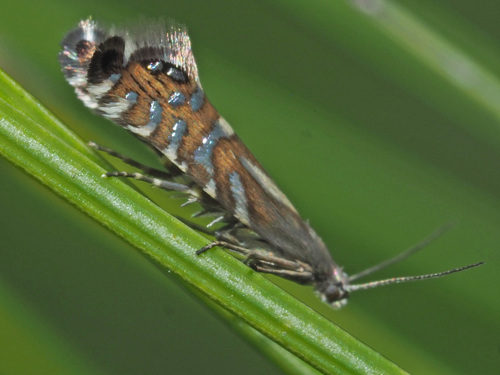
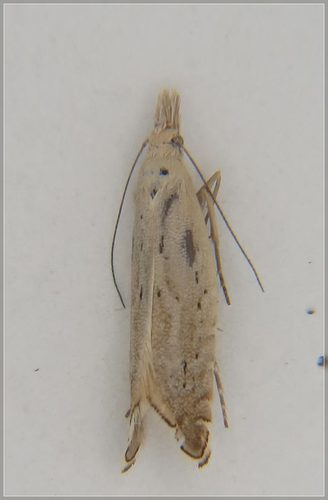
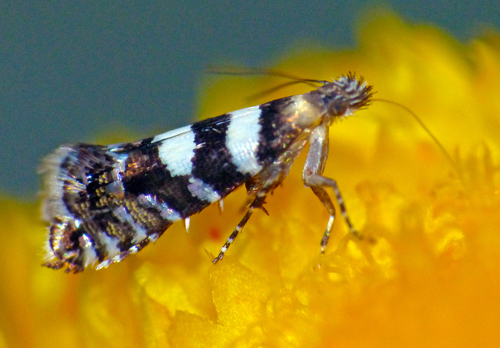
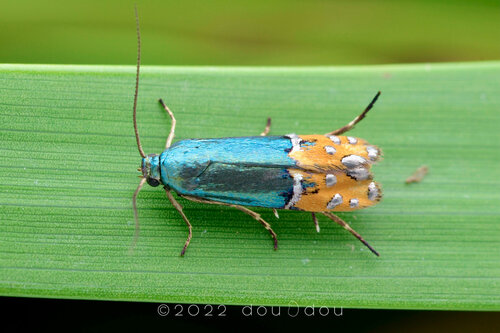
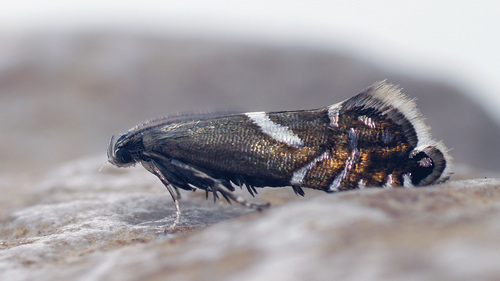
Glyphipterix asteronota Meyrick, 1880 has a forewing length ranging from 3.5mm to 5mm. Meyrick's original description of this species under the name Glyphipterix asteronota is as follows: For male and female specimens, the size is 3+1⁄4. The head, thorax, and antennae are dark fuscous. The palpi are whitish, with faint obsolete darker rings. The abdomen is dark fuscous, with a whitish apex (this detail is marked uncertain). The legs are dark fuscous; the middle and posterior tibiae have whitish central and apical bands, and all tarsi have broad whitish rings at the apex of each joint. Fore-wings are somewhat dilated, with a hind-margin that is rather strongly sinuate beneath the apex; they are dark fuscous. Two prominent clear white semilunate spots sit on the inner margin, reaching halfway across the wing. The first spot is near the base, the second is slightly beyond the middle, both are outwardly oblique, and their apices curve toward the wing apex. There are six slender oblique white streaks from the costa: the first is at 1⁄4; the second is just before the middle, and does not reach halfway across the wing; the third unites with a similar streak from the anal angle to form an outwardly curved transverse fascia; the fourth is short; the fifth and sixth are small, wedge-shaped, and positioned close before the apex. There are some irregular silvery-white scales above the anal angle, beyond the transverse fascia. The cilia are grey (this detail is marked uncertain); the basal half is separated by a black line and covered with dark fuscous scales, except for a wedge-shaped black-margined indentation just below the apex, which contains a whitish spot. The hind-wings and their cilia are dark fuscous-grey (this detail is marked uncertain). Philpott later described this species under the synonym name Glyphipterix plagigera as follows: For male and female specimens, the size is 9+1⁄2-11 mm. The head is ochreous-white. The thorax is fuscous-brown. The palpi are moderately tufted beneath, ochreous-white with 4 faint obscure fuscous rings. The abdomen is blackish-grey, with faint obscure white annulations. The posterior legs are black, with tibiae and tarsi marked with white annulations. Forewings are elongate, moderately dilated toward the posterior, the costa is moderately arched, the apex is obtuse, and the termen is oblique; they are dark greyish-fuscous, with a purplish tint and more or less sprinkled with white on the posterior section. A narrow, outwardly oblique white streak runs from the costa at 1⁄4, reaching near the middle of the wing. There are 5 similar streaks between this first streak and the apex, with the last two being less oblique. A broad white blotch sits on the dorsum near the base, with a similar broad white blotch before the middle, and these two blotches sometimes unite at their apices. An obscure white streak runs from the tornus, and sometimes unites with the third costal streak. The cilia are fuscous-grey, with a darker median line and apical hook. Hind-wings are broadly lanceolate, they are fuscous-grey, and their cilia are also fuscous-grey. This species is endemic to New Zealand, and is common throughout the country. Larvae currently associated with this species complex (referenced as G. tungella) are leaf miners that feed on small sedges. The species prefers sheltered shrub areas, grassy areas, and forest clearings. Specimens have been collected at Kānuka scrub sites.