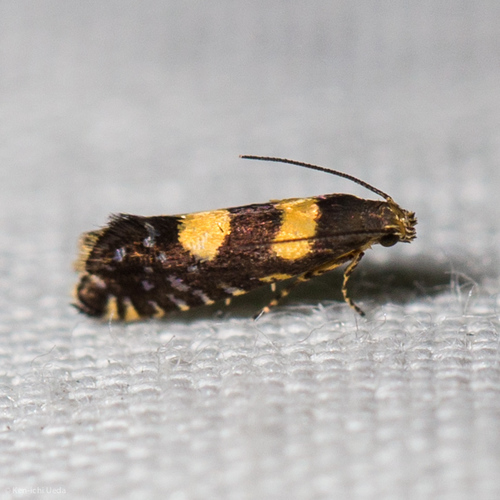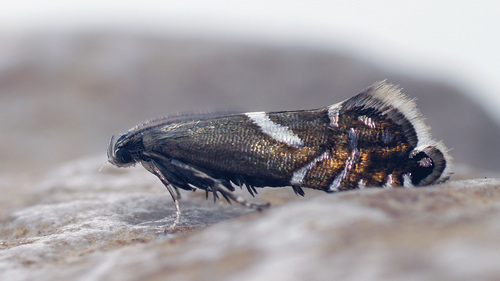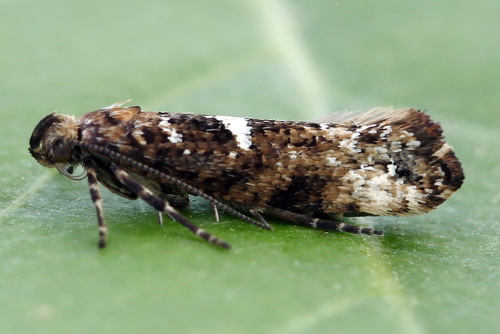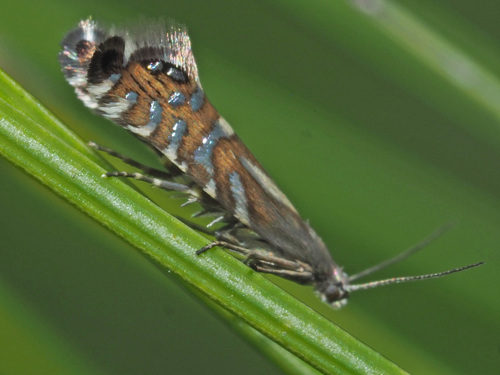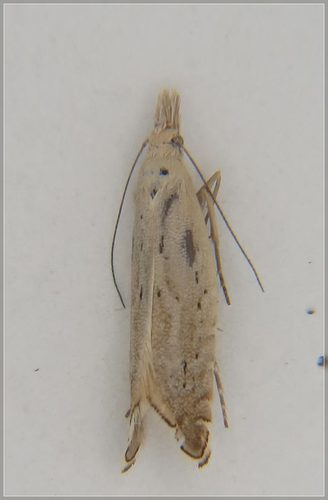
About Glyphipterix achlyoessa Meyrick, 1880
Glyphipterix achlyoessa was first described by Meyrick in 1880. Meyrick's original description of the species is as follows: the head and thorax are whitish-grey. The palpi are whitish-grey, mixed with dark fuscous, and the second joint has a long, loose projecting fringe of hairs along its underside. The antennae are dark fuscous. The abdomen is elongated and dark fuscous. The legs are pale ochreous-grey. The fore-wings are elongated and narrow, with a hind-margin that is strongly sinuate below the apex; they are pale whitish-grey, with faint transverse darker strigulation. A small number of isolated black scales are present, and these tend to be arranged longitudinally along the fold and the lower median vein. The fore-wing cilia are whitish, with an obscure dark fuscous apical hook; the basal portion of the cilia is separated by a blackish line and colored dark smoky-grey. Both the hind-wings and their cilia are fuscous-grey. This moth is endemic to New Zealand, found across the whole country, and is considered a common species. It prefers to live in meadows and open grassy spaces, and appears to favor introduced grass species. A confirmed host plant for this species is Dactylis glomerata. Its larvae have also been found boring into plants from the genus Juncus.