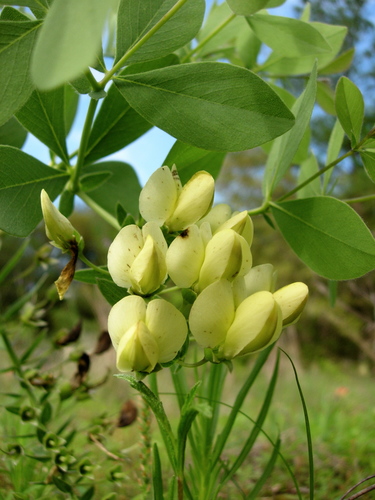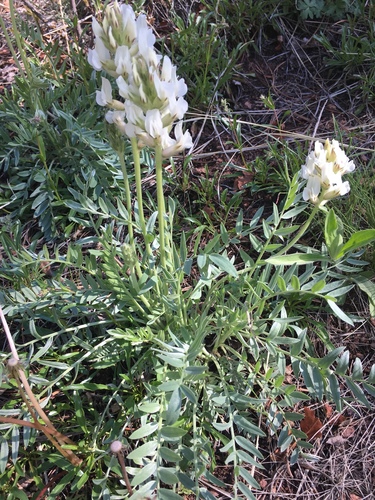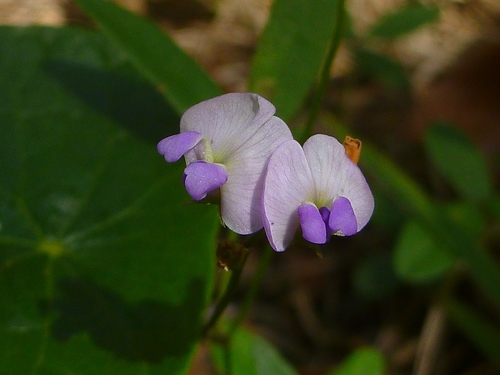
About Glycine tabacina (Labill.) Benth.
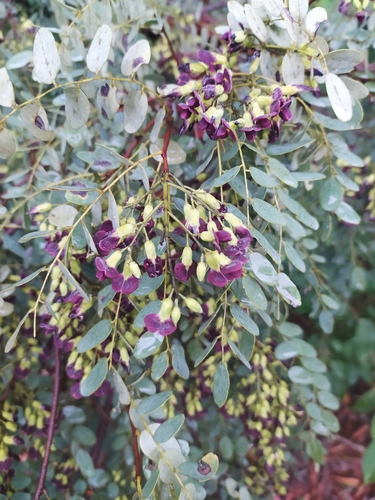
Glycine tabacina (Labill.) Benth. is one of 26 perennial species in the genus Glycine. This species can be identified by its lengthy leaflet stalks. Its pea-shaped flowers range in color from purple to mauve, and bloom from spring through autumn. Mature pods of this species turn black, and contain 4 to 8 red to brown seeds. Stems are typically slender, reach up to 1 meter in length, grow trailing, creeping, and often twining. Stems are often covered in stiff, straight hairs, and emerge from a thickened root system. Leaves are typically tri-foliolate pinnate, with a rachis that ranges from 5 to 45 mm in length, and has pubescence similar to the stem. Leaflets are generally narrow, with straight, stiff strigose hairs on their lower surface; the upper surface may be sparsely strigose or glabrous (lacking straight stiff hairs). The apical leaflet of this species is generally broader or longer than the lateral leaflets. Lower leaves are typically broad, oval to elliptic, measuring 10-15 mm by 8–14 mm. They are obtuse to truncate, acute, taper at the base, and often have noticeable net-veining on the lower surface. Upper leaflets are normally elliptic-lanceolate to slightly linear, measuring 7-50 mm by 3–7 mm. They are sharp to blunt and apiculate, with bases ranging from abruptly sharp to curved, and their petiolules are covered in coarse, long hairs. Most leaflets fall between 20-40 mm by 10–20 mm, and are elliptical to widely oblong. Stipels are acicular, 1 to 1.5 mm long. Stipules range from deltoid to oblong-lanceolate, 1.5–3 mm long. Flowers are 6 to 8 mm long, and grow on strigose pedicels that reach 0.5 to 2 mm long. Distal racemoids (intermediate inflorescences with flowers growing at a single angle) on the flower stalk measure 2 to 12 cm in length, and generally hold 4 to 12 flowers. Bracts, reduced leaves at the base of individual flowers, are 1 to 2 mm long and slender. The calyx (sepals) grows 3 to 4 mm long, and can be either strigose or glabrous. This plant is insect-pollinated, hermaphroditic (bearing both male and female reproductive cells), and capable of nitrogen fixation. It accomplishes biological nitrogen fixation through a symbiotic relationship with specific nitrogen-fixing microbes; these microbes form nodules on the plant's roots and convert atmospheric nitrogen to ammonia for the plant. Glycine tabacina is native to Australia, and can also be found in China, Pacific Islands, Papua New Guinea, Indonesia, Philippines, and Taiwan. In Australia, it occurs mostly in New South Wales, Queensland, Victoria, and Western Australia, and is commonly and widely scattered across populated areas in Eastern Australia. It typically grows among grasses in open forests and woodlands. It can also be found in dense forests and rainforest riverbeds, though it is uncommon near ocean shores. It thrives in moist loamy clay soils, does not require shade, and tolerates pH levels from acidic to alkaline. After fire events, it can resprout from its root and regenerate extensively from seed. No toxic compounds have been found in this species to date. It acts as a nectar source for butterflies and a food source for some groups of caterpillars. Indigenous Australian communities have consumed its liquorice-flavored root. First Nations peoples in New South Wales and Queensland have been recorded roasting, crushing, and chewing the root, then expectorating the fiber. The root is fibrous but starchy, with no discernible taste other than the liquorice flavor. It is not known whether Aboriginal communities currently consume the roots of Glycine tabacina, nor whether they use this plant for medicinal purposes. Glycine tabacina is a legume known as a natural remedy and a Chinese herbal medicine. Its roots have been used in traditional medicine to treat osteoporosis, nephritis, rheumatism, and menopausal syndrome. It is often made into an herbal tea in Taiwan, and is one source of the folk medicine I-TiaoGung. Several phytochemical and pharmacological studies have examined this plant. In vitro tests have found its extract has anti-inflammatory, anti-arthritic, antioxidant, and antidiabetic properties. A 2019 study led by Yanbei Tu examined the anti-arthritic effect of an ethanol extract of Glycine tabacina on a mouse model of collagen-induced arthritis. For 30 days starting on day zero, mouse subjects received daily oral doses of 1.11g, 2.22g, or 4.44g of Glycine tabacina extract powder. Arthritis severity was assessed via paw width measurements, arthritis index scores, X-ray analysis, histopathological changes, and swelling size. Physical examination of the mouse models showed that oral administration of Glycine tabacina extract substantially reduced arthritic symptoms in collagen-induced arthritis mice. X-ray and histopathological analyses confirmed that the extract actively protected cartilage and bone joints from degeneration, lesion formation, and distortion. The study also measured serum levels of the cytokines IL-1β, IL-6, and TNF-α on days 14, 21, and 28, finding significantly reduced cytokine serum levels, which further validated the plant's anti-arthritis activity. In rheumatoid arthritis, oxidative stress contributes to chronic inflammation: neutrophils in the joint produce increased reactive oxygen species (ROS) that damage cartilage and bone. Increased ROS also causes lipid peroxidation, DNA damage, and reduces the activity of endogenous antioxidant defenses like SOD and catalase. The cytokine TNF-α plays a major role in regulating rheumatoid arthritis activity, and worsens inflammation by producing more ROS when oxidative stress is high. The 2019 study found that T-SOD activity in the serum of arthritic experimental subjects was reduced, but increased significantly after treatment with Glycine tabacina ethanol extract (GTE). Treatment with GTE also produced a significant decrease in MDA levels. These results suggest that GTE may exert its anti-arthritic properties by alleviating oxidative stress. While the full chemical composition of GTE is not yet fully known, HPLC analysis in the study found that this plant contains abundant common isoflavonoids including genistin, daidzein, genistein, and pratensein, which may be the source of GTE's anti-arthritic activity. The isoflavonoid genistin has been shown to inhibit osteoclast differentiation and promote osteoclast proliferation, and reduces collagen II-induced arthritis in mice and rats. A 2020 study led by Lihua Tan investigated the medicinal mechanisms and effects of an aqueous extract of Glycine tabacina for treating nephrotic syndrome in mouse models. The study examined movement, weight change, water content, and food intake in mice injected with Adriamycin (ADR) to induce nephrotic syndrome. After administration of Glycine tabacina aqueous extract (GATE), mice with nephrotic syndrome showed significantly reduced urinary protein levels and improved hyperlipoproteinemia symptoms, demonstrated by lower urinary protein and albumin excretion, and reduced plasma total cholesterol and triglyceride levels. GATE also improved food intake and movement, and reduced weight loss. This study was the first to show that GATE can substantially improve heavy proteinuria, declining renal function, and hyperlipidemia, opening new potential pathways for the prevention and treatment of nephrotic syndrome (NS) and other kidney diseases. Reduced blood urea nitrogen and creatinine levels in treated mice indicate that Glycine tabacina aqueous extract may protect kidneys from adverse drug reaction damage. Histological examination found that ADR treatment caused notable damage to renal tissues including glomerular deformation and tubular damage, while GATE treatment reduced these ADR-induced damages, confirming its protective effect against ADR-induced renal injury. Network pharmacology analysis used to better understand how GATE treats nephrotic syndrome found that GATE acts on multiple targets and pathways related to nephrotic syndrome, and the expected targets and pathways are closely linked to inflammation and oxidative stress. The 2020 study further found that renal tissues of ADR-injected mice produced relatively higher levels of intracellular reactive oxygen species (ROS), and GATE treatment substantially reversed this ADR-induced change. Compared to ADR-injected mice, GATE-treated mice had reduced MDA (Malonaldehyde) levels. SOD activity was reduced in renal tissues and plasma of ADR-injected mice with nephrotic syndrome, and GATE treatment restored this SOD activity. These results, consistent with network pharmacology findings, suggest that GATE protects mice from renal injury by mitigating ADR-induced oxidative stress and inflammation in nephrotic syndrome mice.