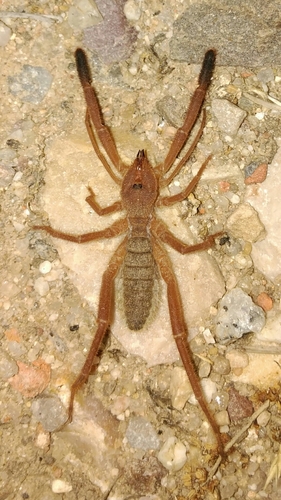
About Gluvia dorsalis (Latreille, 1817)
Gluvia dorsalis is a species of solifuge, a type of carnivorous arachnid. It was originally described under the names "galeode dorsale" and Galeodes dorsalis, with an original reported length of half an inch, and was first recorded from the southernmost part of Spain. It remained the only valid species in the genus Gluvia for over 200 years, until the description of Gluvia brunnea in 2024. The two species can be distinguished by color: G. dorsalis has yellow areas on its palps and legs, while G. brunnea has a completely brown dorsal region. G. dorsalis has very closely set eyes, which are described as "as small as half the length of the eyes" in original sources. Unlike G. brunnea, G. dorsalis does not have a hypertrophied seta (hair) on the coxa, the first segment of the leg. Additional identifying traits are unique to adult male G. dorsalis, and involve features of the flagellum, the mucron of the fixed finger, and most noticeably a skirt-like row of bristles on the ventral side of the fourth tergite of the opisthosoma, also called the abdomen. This species shows clear sexual dimorphism: males have narrower propeltidia, wider malleoli, and dense spines on the sclerotized (hardened) parts of their body, while females have a larger overall body size. The sex ratio of G. dorsalis is heavily skewed toward females. Reproduction takes place at the start of summer, and the species is a seasonal breeder. On average, females lay eggs 11 days after mating, producing a clutch of between 47 and 163 eggs inside a burrow. Females die approximately one week after laying their eggs. In laboratory conditions, eggs hatch around 60 days after being laid; researchers presume development happens twice as fast in wild populations due to higher natural ambient temperatures. G. dorsalis is thought to be a biennial species, overwintering several times before reaching maturity, with an approximate total longevity of 700 days.

