About Gloydius brevicauda (Stejneger, 1907)
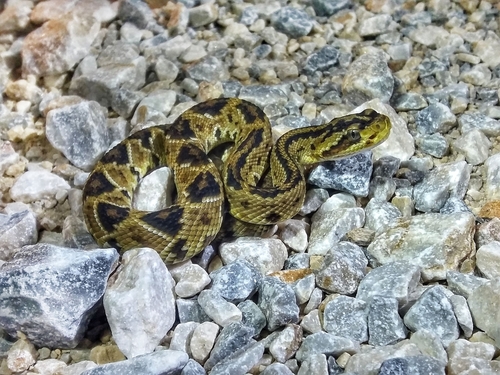
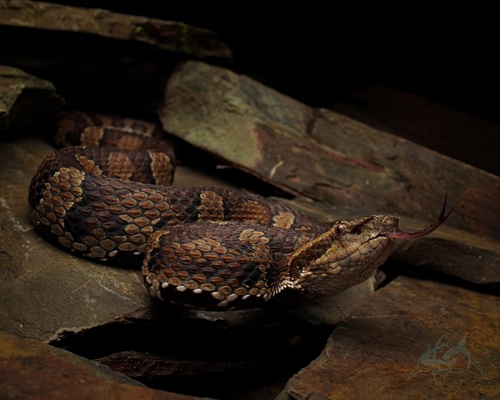
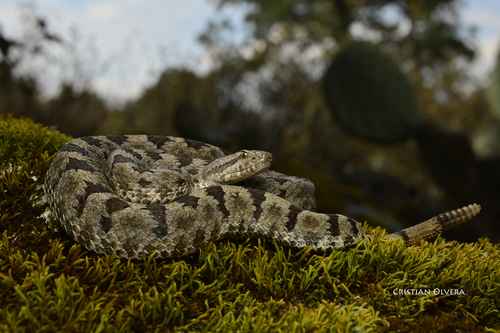
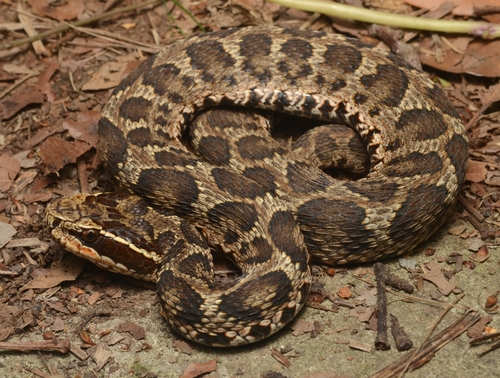
Gloydius brevicauda (Stejneger, 1907) is a species of viper. Adult individuals have relatively stout bodies, broad heads, and short tails; the species epithet brevicauda comes from Latin meaning "short tail". In a 1990 examination by Gloyd and Conant, the largest measured male had a total length of 71 cm (28 in), with a 9 cm (3+1⁄2 in) tail. The largest measured female had a total length of 69 cm (27+1⁄4 in), with an 8.2 cm (3+1⁄4 in) tail. On average, the tail of male specimens makes up 12–15% of total body length, with an average of 13.5%. For females, the tail makes up 11–13% of total body length, with an average of 11.7%. This species typically has 21 rows of dorsal scales at midbody; all dorsal scales are keeled, except for the lowermost scales on the anterior portion of the body. It has between 135 and 149 ventral scales, and between 30 and 44 mostly paired subcaudal scales. 95% of all examined specimens have 7 supralabial scales. The species' color pattern has a light brown or gray base color, overlaid with 23–36 pairs of dorsolateral blotches or half-bands that either oppose or alternate on either side of the middorsal line. These blotches are subelliptical in shape and brown in color, with pale centers and dark brown to grayish brown borders. Paired blotches may or may not touch each other along the midline. Blotches are separated laterally by light-colored areas about one scale wide, which extend downward to the second or third scale rows. A dark, clearly defined postocular stripe is present on the head, which is sharply bordered both above and below by yellow or white. The tip of the tail is yellow. This species is found in Manchuria (China) and the Korean Peninsula. Its type locality is recorded as Busan (Pusan), South Korea.