About Glossopetalon spinescens A.Gray
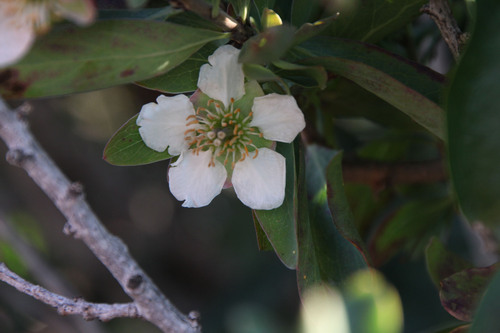
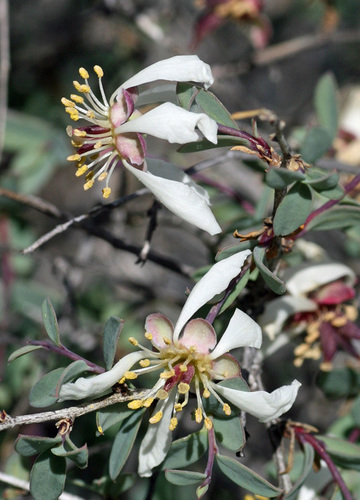
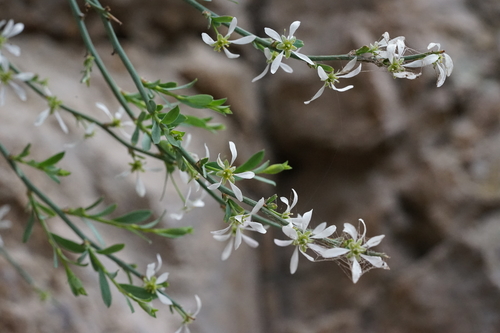
This species is a shrub that grows into a dense, erect clump made up of many thin, branching, thorny stems, reaching a maximum height of close to 3 metres (9.8 ft). Its green oval leaves are less than two centimetres long. Small flowers with white petals grow in the leaf axils. The fruit is a single or double follicle a few millimetres wide and 3 to 5 millimetres long. A follicle is a type of fruit that splits lengthwise when ripe to release its seeds. The fruit is longitudinally striated or ribbed; it is green when young, and turns light brown as it matures. Glossopetalon spinescens has a wide distribution range, stretching from southeastern Washington state in the north, south to isolated, disconnected populations in southern Mexico, found in the Mexican states of Guanajuato, Oaxaca, Tlaxcala, Veracruz, Chihuahua, Coahuila, Nuevo León, Sonora and Tamaulipas. In the United States, it can be found, from north to south and west to east, in the states of Washington, Idaho, Montana, Oregon, Wyoming, California, Nevada, Utah, Colorado, Arizona, New Mexico, Oklahoma and Texas. It is not widespread across these US states, instead being localized to a number of counties. Overall, this is a rare plant that most often occurs in scattered concentrated groups. It is especially rare in Montana and Wyoming, where it only occurs in a single county in each state: Beaverhead County in Montana, and Sweetwater County in Wyoming. This plant grows in chaparral and brush areas, rocky slopes, canyons, and cliffs. It is found growing in calcareous soils formed from limestone. In Arizona, it occurs at altitudes between approximately 850 and 2200 metres. It grows on hillsides, rocky slopes, and crevices and ledges of cliffs in canyons and outcrops, within habitats including desert scrub, grasslands, chaparral, and juniper woodland. Across its entire range, it flowers from March to September; in Arizona, it flowers from March or April to May.