About Gloriosa superba L.
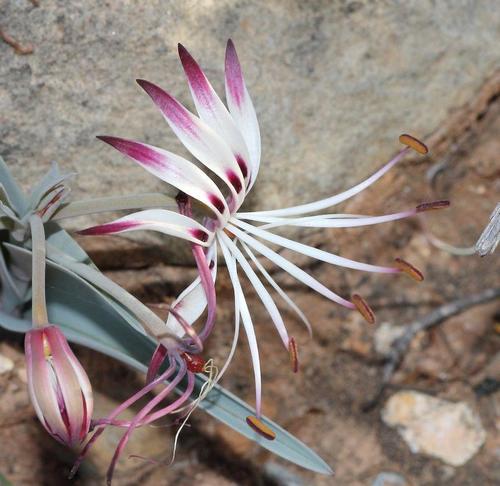
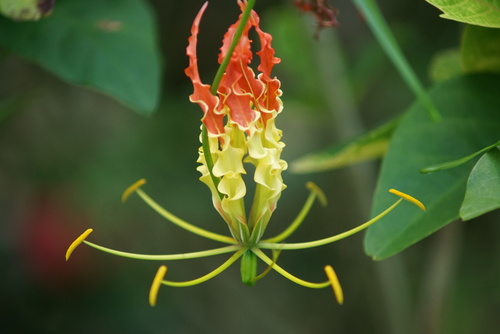
Gloriosa superba L. is a herbaceous perennial plant that grows from a fleshy rhizome. It is a scandent climbing plant that uses modified leaf-tip tendrils to climb, with stems that can reach 4 meters (13 feet) in length. Its leaves are mostly alternately arranged, though some may be opposite; they are somewhat lance-shaped, tipped with tendrils, and measure 13 to 20 centimeters (5.1 to 7.9 inches) long. The plant produces showy flowers with six tepals, each 5 to 7.6 centimeters (2.0 to 3.0 inches) long. Mature tepals are generally bright red to orange, sometimes with yellowish bases, and their margins may be noticeably wavy. The six long stamens grow up to 4 centimeters (1.6 inches) long, each holding a large anther that releases large amounts of yellow pollen. The style can be more than 6 centimeters (2.4 inches) long, and a single flower may weigh over 2.5 grams (0.09 ounces). The fruit is a fleshy capsule 6 to 12 centimeters (2.4 to 4.7 inches) long that contains red seeds. As a popular garden plant, cultivars may differ from wild-type characteristics: the 'Lutea' cultivar has all-yellow tepals, 'Citrina' is yellow with red markings, 'Nana' is a dwarf, and whitish forms are also known.
Gloriosa superba is native to most of Africa, excluding North Africa, as well as much of tropical Asia including the Indian subcontinent, mainland and maritime Southeast Asia, and south-central China. It has been introduced to eastern Australia (New South Wales and Queensland), Alabama in the United States, Suriname, parts of the Caribbean, and various Pacific Islands. The plant is likely pollinated by butterflies and sunbirds. It grows in many habitat types including tropical jungles, forests, thickets, woodlands, grasslands, and sand dunes, and can tolerate nutrient-poor soils. It can be found at elevations up to 2,500 meters (8,200 feet).
All parts of this plant are poisonous, especially the tuberous rhizomes, and ingestion can be fatal to humans and animals. It has been used for murder, suicide, and killing animals. Like other members of the Colchicaceae family, Gloriosa superba contains high levels of the toxic alkaloid colchicine, and also contains the alkaloid gloriocine. Within a few hours of ingesting a toxic amount of plant material, a victim may develop nausea, vomiting, numbness, tingling around the mouth, throat burning, abdominal pain, and bloody diarrhea that leads to dehydration. As poisoning progresses, symptoms can include rhabdomyolysis, ileus, respiratory depression, hypotension, coagulopathy, haematuria, altered mental status, seizures, coma, and ascending polyneuropathy. Longer-term effects include skin peeling and prolonged vaginal bleeding in women. Colchicine is known to cause alopecia; one case report documented a patient who accidentally ate the tubers and experienced full-body hair loss, including complete baldness. Poisoning often occurs when the tubers are mistaken for sweet potatoes or yams and eaten. The plant is also dangerous to cats, dogs, horses, and livestock.
Alkaloid-rich Gloriosa superba has a long history of use as a traditional medicine across many cultures. It has been used to treat gout, infertility, open wounds, snakebite, ulcers, arthritis, cholera, colic, kidney problems, typhus, itching, leprosy, bruises, sprains, hemorrhoids, cancer, impotence, nocturnal emission, smallpox, sexually transmitted diseases, and many types of internal parasites. It acts as an anthelmintic, laxative, and alexiteric. Its sap is used to treat acne and head lice. In pregnant people, it can induce abortion. In parts of India, rhizome extracts are applied topically during childbirth to reduce labor pain. Other human uses include making arrow poison in Nigeria and use as a snake repellent in India. Some cultures consider the plant magical, and its flowers are used in religious rituals.
This species is the national flower of Zimbabwe. In 1947, Queen Elizabeth II received a diamond brooch shaped like this flower for her 21st birthday while traveling in Rhodesia, the former name of Zimbabwe. In Tamil, the flower is commonly called Karthigaipoo because it grows during the Tamil month of Karthigai, which falls in November to December. It is the state flower of Tamil Nadu, India. It was also designated the national flower of the de facto state of Tamil Eelam by the Liberation Tigers of Tamil Eelam (LTTE), because it contains all the colors present in the Tamil Eelam national flag, and its growing season in November coincides with Maaveerar Naal.
For cultivation, Gloriosa superba can be propagated sexually by seed or vegetatively by dividing the rhizome. Common cultivation issues include inadequate pollination, fungal diseases such as leaf blight and tuber rot, and pest damage from moths including Polytela gloriosa and Chrysodeixis chalcites. The plant propagates slowly: each split tuber produces only one extra plant per growing season. In vitro experiments using plant tissue culture have been conducted, and some of these experiments increased propagation yield. Both the fruit and rhizome are harvested. Fruits are dried and split, after which the seeds are removed and dried further. Seeds and rhizomes are sold whole, as powder, or as oil extracts.