About Glomeris marginata (Villers, 1789)
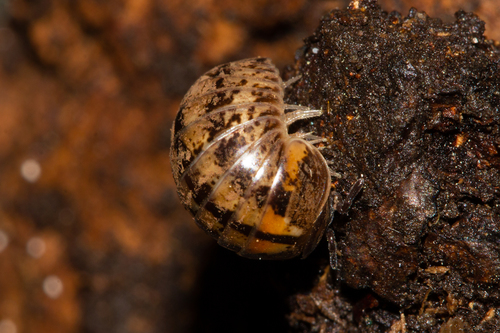
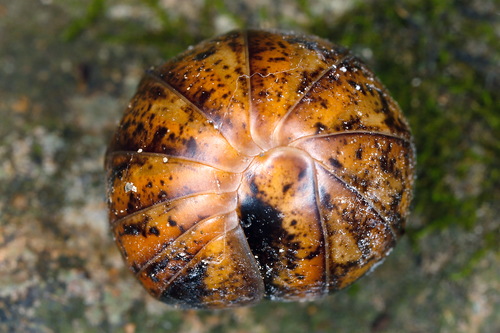
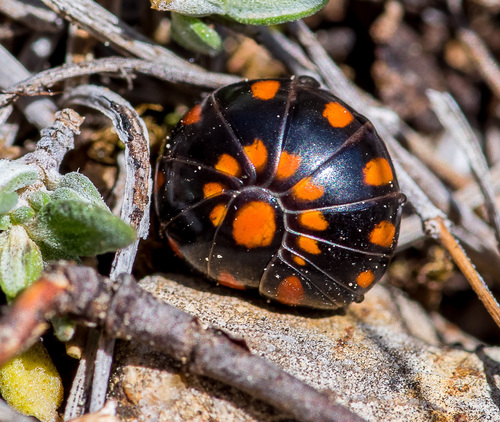
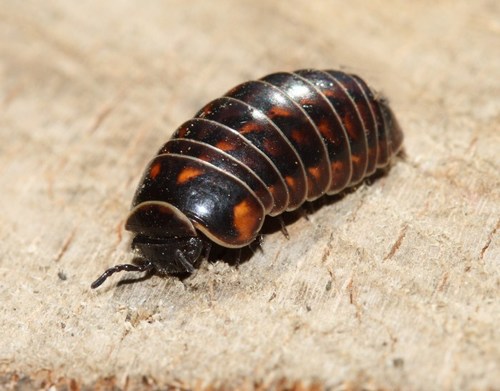
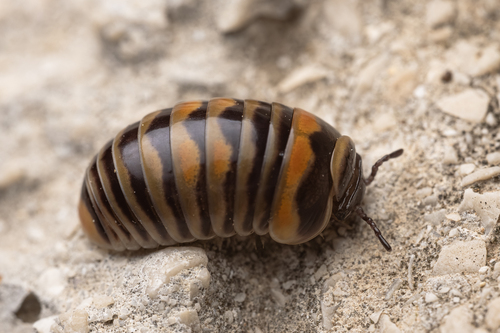
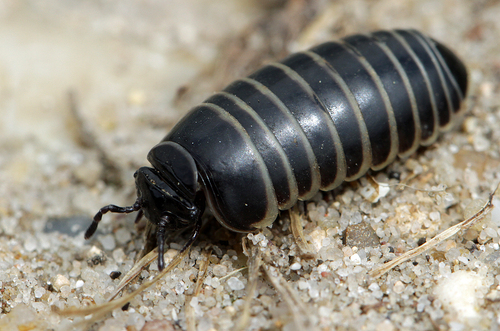
Adult female Glomeris marginata measure 8–20 mm long and 4–8 mm wide, while adult males are smaller at 7–15 mm long and 3.5–6 mm wide. Adult bodies behind the head are covered by 12 tergites (dorsal plates), counting the collum as the first tergite and the anal plate (telson) as the last. In cross-section, these tergites have a semicircular arch. Tergites are usually black with pale edges, but may also appear brown, red, or yellow. Like other species in the order Glomerida, G. marginata has a reduced collum, while the second tergite (thoracic shield) is enlarged to almost twice the size of the tergites that follow it. When the millipede rolls into a complete ball, it hides its head and collum inside the roll, and the anal shield covers the front edge of the thoracic shield. Fully rolled G. marginata forms an oblate spheroid pill shape, with a slightly larger vertical diameter than transverse width. Also matching other Glomerida, adult females of this species have 17 leg pairs, while adult males have 19 leg pairs. Juveniles develop through a series of molts, adding tergites and legs until they reach the adult segment and leg count; after reaching adulthood, they continue to molt but do not add more segments or legs. This developmental pattern is called hemianamorphosis. First-stage juveniles hatch with 8 tergites, 3 functional leg pairs, and 5 pairs of distinct leg buds. Second-stage juveniles have 8 tergites and 8 leg pairs; third-stage have 9 tergites and 10 leg pairs; fourth-stage have 10 tergites and 12 or 13 leg pairs; fifth-stage have 11 tergites and 15 leg pairs; and sixth-stage juveniles already have the full adult counts of tergites and legs. G. marginata (a pill millipede) can be easily distinguished from the similar-looking pill woodlouse by several key traits. Adult pill woodlice only have 7 pairs of walking legs, while adult G. marginata have far more leg pairs, and even juvenile G. marginata have at least 8 leg pairs or visible leg buds. The rear end of G. marginata is protected by a single large anal shield, while the rear end of a pill woodlouse is made of multiple smaller plates, with one uropod on each side of the telson. When rolled into a ball, G. marginata forms the oblate spheroid pill shape noted above, while pill woodlice roll into much more perfect spheres. The cuticle of G. marginata is also darker and shinier than a pill woodlouse’s surface. G. marginata also has shorter, club-shaped antennae tips, while pill woodlice have a flagellum at the end of each antenna. Glomeris marginata is distributed across Europe, from the Pyrenees to the British Isles, southern Scandinavia, and the coastal plain of Poland. It has been recorded in Spain, France, Belgium, the Netherlands, Germany, Switzerland, Austria, and Denmark, as well as in Sweden south of Lake Vänern and along the east coast of southern Norway. In the British Isles, it is common in England, Ireland, and Wales, and only reaches as far north as the Midland Valley in Scotland. It is most abundant in western Europe near the Atlantic Ocean. This species avoids prolonged cold, and is rarely found at elevations above 300 meters above sea level. Glomeris marginata inhabits leaf litter, grassy areas, and spaces under stones, and prefers calcareous soils. It can often be found in domestic gardens along hedgerows and at the base of old crumbling walls, where leached lime from mortar enriches the soil. It tolerates dry, harsh conditions better than many other millipedes, and individuals can be found on hot dry sand in the middle of the day. Even so, it is most active at night and prefers more humid microhabitats. It feeds primarily on old decaying leaves, even though freshly fallen leaves are more easily digestible. This species plays an important role in recycling nutrients from leaf litter. Known predators of G. marginata include starlings, common toads, and woodlouse spiders. In addition to rolling into a protective ball, G. marginata produces defensive noxious chemicals to repel predators, like most millipedes. When attacked, it secretes 1 to 8 drops of a viscous fluid that contains the quinazolinone alkaloids glomerin and homoglomerin, dissolved in a watery protein matrix. These chemicals act as antifeedants and toxins to spiders, insects, and vertebrates, and the sticky fluid can trap the legs of ants. After fully expelling its defensive chemical supply, G. marginata can take up to four months to replenish its stores. Juvenile G. marginata take multiple years to develop into mature adults. By the sixth anamorphosis stage, they reach the full adult count of tergites and legs, but continue to develop through additional epimorphic molts. During these epimorphic molts, the last three leg pairs of males differentiate and become modified for mating: the last pair grows largest and becomes telopods, while the two preceding pairs become paratelopods. Juveniles reach the second, third, or fourth anamorphosis stage by their first winter. They reach the fifth, sixth, or seventh development stage by their second winter, and the seventh, eighth, or ninth life stage by their third winter. Males reach maturity at the seventh stage, so they are ready to breed by their second or third spring. Females reach maturity at the eighth stage, so they are not ready to breed until their third or fourth spring. Adults are present year-round, but are most often collected in spring and autumn. Males produce a pheromone from a gland behind their last pair of legs, which they use to communicate with females and prepare females for mating. During mating, the male grasps the female with his telopods, then produces a sperm droplet from a genital opening behind his second leg pair. He passes the sperm pellet from leg to leg to his telopods, which then deposit the sperm into the female’s genital opening between her second and third leg pairs. After fertilization, the female produces around 50 eggs, each 0.8 mm in size. The female does not build a nest for the eggs; like other Glomerida females, she encloses each individual egg in a capsule made of soil passed through her gut. Females survive after laying eggs and can breed again in subsequent years. After first reaching maturity, females can live long enough to produce seven or eight more annual broods. Glomeris marginata can live up to 10 or 11 years. Adults molt once per year, and can reach 15 or 16 total life stages over their lifespan.