About Gloeophyllum sepiarium (Wulfen) P.Karst.
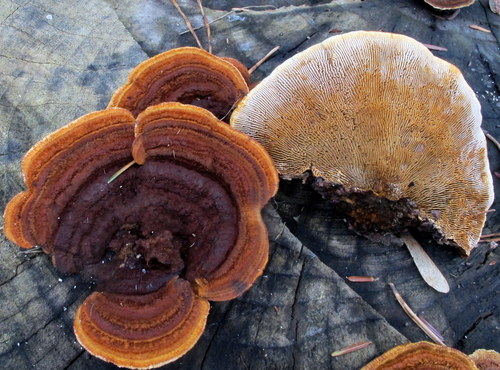
The cap of Gloeophyllum sepiarium measures 1.5–15 centimetres (1⁄2–6 in) wide, and has a loosely fan-shaped form. When actively growing, the cap is brown with a yellow-orange margin; its texture starts velvety and becomes smooth with age, and it has a leathery consistency with a mild odor and mild taste. The tannish flesh of this fungus darkens when tested with potassium hydroxide (KOH). The gills are adnate, closely spaced, pale when fresh, and turn darker both near the wood substrate and as the mushroom ages. The individual spores are white, cylindrical, and smooth, and the spore print produced is white. The annual fruiting body lives for only one year, and releases spores during late summer and autumn. Unlike most other polypore species, Gloeophyllum sepiarium has a distinctive hymenial surface that bears true gills. This species is classified as inedible. For habitat and distribution, Gloeophyllum sepiarium grows on dead conifer wood, both in natural wild settings and on processed lumber. It can be found across the entirety of North America.