About Globifomes graveolens (Schwein.) Murrill
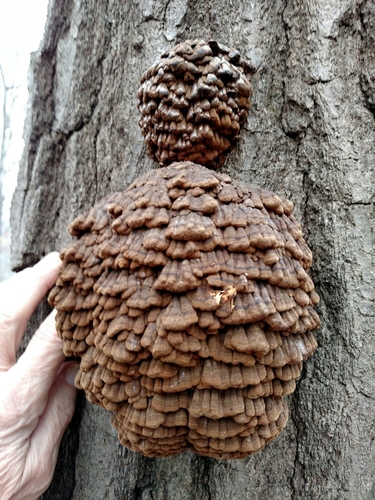
Murrill described the generic characteristics of Globifomes as: "Hymenophore large, woody, encrusted, perennial, epixylous, compound; context ferruginous, pinky, tubes cylindrical, thick-walled, stratose; spores ovoid, smooth, ferruginous." The fruit bodies of Globifomes graveolens are 5–20.5 cm (2.0–8.1 in) in both width and height. They are made up of small overlapping, stipe-less caps that grow from a central core. The caps have a leathery to rigid texture, a slightly velvety surface, and radial wrinkles along their edges. Adjacent caps may fuse together, and have projecting, petal-shaped margins. Young caps are dull yellow-brown with a tan margin, and mature to dark brown to greyish black as they age. The fibrous, tough flesh is yellowish brown, and grows up to 6 mm (0.24 in) thick. The pore surface is initially purplish gray, then turns dark grayish brown; it is made of small circular pores, with 3–5 pores per millimeter. The spores produced by the fungus are cylindrical, thin-walled, and hyaline (translucent), measuring 10–14 by 3–4.5 μm. They are inamyloid, and Globifomes graveolens produces a brown spore print. Globifomes graveolens causes white rot in the heartwood of broadleaf trees. It is most commonly found on oak, with Murrill noting a preference for water oak, and also occurs on beech. Fruit bodies grow on both living and dead broadleaf trees.