About Globicephala melas (Traill, 1809)
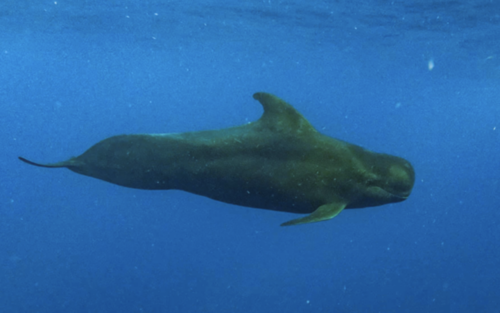
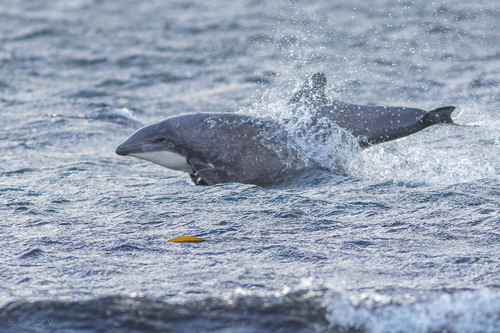
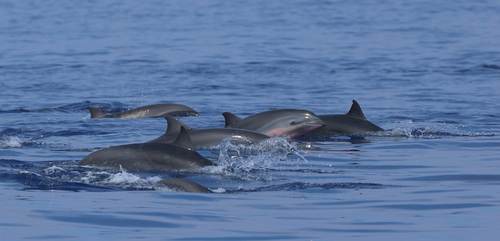
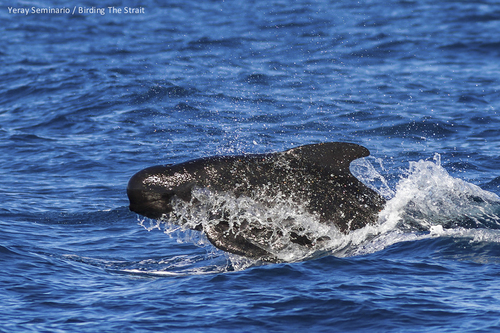
The long-finned pilot whale, also called the pothead whale (scientific name Globicephala melas), is a large species of oceanic dolphin. It shares the genus Globicephala with the short-finned pilot whale (Globicephala macrorhynchus). This species gets its common name from its unusually long pectoral fins.
Long-finned pilot whales have two currently recognized living subspecies based on distribution: Globicephala melas melas in the North Atlantic, and Globicephala melas edwardii in the Southern Hemisphere. Populations in the North Atlantic are wide-ranging; they have been observed off the coast of the eastern United States and Canada, across the Atlantic at locations including the Azores and the Faroe Islands, and down the western coast of Europe all the way to the Strait of Gibraltar and North Africa. In the Southern Ocean, long-finned pilot whales are thought to range between 19° and 60° S, but they are commonly sighted in the Antarctic Convergence Zone and other areas, confirming they travel as far south as 68° S. This species has also been observed near sea ice in the Antarctic.
Though only two living subspecies are recognized today, a third population of long-finned pilot whale once existed in the western North Pacific, around Japan. This unnamed form is thought to have gone extinct sometime between the 8th and 12th centuries. Its former presence is documented in historical literature and confirmed by fossils discovered at multiple sites in Japan, including Rebun Island and Chiba Prefecture. After this population went extinct, its biological niche was likely filled by short-finned pilot whales, which currently live in parts of this region.
For reproduction, female long-finned pilot whales reach sexual maturity at around 8 years of age, while males reach sexual maturity at approximately 12 years of age. Mating can occur at any time of year, but peaks in late spring to early summer for populations in both the northern and southern hemispheres. Mating is thought to happen when different social groups gather, and breeding within a single social unit is rare. Gestation lasts approximately 12 to 16 months, and a single calf is born once every 3 to 6 years. At birth, calves are generally 1.6 to 2.0 meters (5 feet 3 inches to 6 feet 7 inches) long and weigh around 75 kilograms (165 pounds). Most calves are born in the summer, though some calving happens throughout the year. There is evidence that some males remain with their mothers after reaching sexual maturity.