About Glis glis (Linnaeus, 1766)
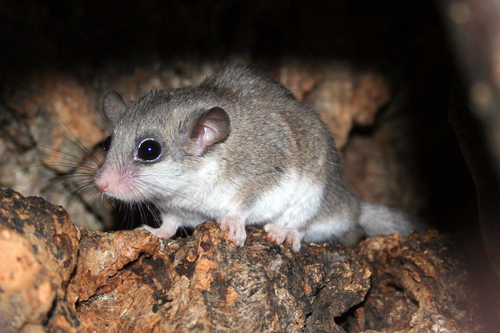
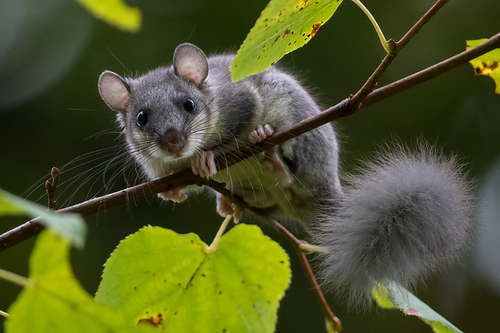
Glis glis, commonly called the European edible dormouse, is the largest living dormouse species. It has a head-body length of 14 to 19 cm (5.5 to 7.5 in), plus a tail 11 to 13 cm long. Its typical weight ranges from 120 to 150 g (4.2 to 5.3 oz), but it can nearly double this weight just before hibernation. It has an overall squirrel-like build with small ears, short legs, and large feet. Most of its body fur is grey to greyish-brown, while its underparts and the inner surfaces of its legs are white to pale buff, with a clear line dividing these two color regions. Unlike most other dormice, it has no dark facial markings except for faint rings around the eyes. Its long, bushy tail is covered in fur that is slightly darker than the fur on its body. It has four digits on its front feet and five on its hind feet, and the soles of its feet are hairless. Females have between four and six pairs of teats. The edible dormouse can perform limited autotomy: if another animal grabs its tail, the tail skin breaks easily and slips off the underlying bone, letting the dormouse escape. The exposed vertebrae then break off, the wound heals over, and a new short brush of hair forms in the area. Its diet typically includes nuts and a variety of fruits, with a particular preference for berries such as blueberries. It also eats fruits like apples and cherries, and occasionally consumes insects such as mealworms. The edible dormouse is found across most of mainland western Europe, and also lives on multiple Mediterranean islands including Sardinia, Corsica, Sicily, and Crete. It has a sparser distribution across central and southeastern Europe, ranging as far northeast as the upper Volga River in the Zhiguli Mountains of western Russia, and is also present in the Caucasus region. Germany hosts a small population of edible dormice, with densities of two to six individuals per hectare. It also occurs in scattered populations throughout Thrace, a southeastern European region along the Aegean and Black Seas, where two subspecies (G. g. glis and G. g. orientalis) are found. Northern Anatolia is home to a different subspecies, G. g. pindicus. A small, isolated population of Glis glis also lives in southeast England. At the start of the 20th century, British banker and zoologist Lionel Walter Rothschild held Glis glis in his private collection in Tring, Hertfordshire; in 1902, some individuals escaped, reproduced, and established a wild invasive population. Today, the British edible dormouse population is estimated to be 10,000 strong, and the species has been recorded within a 25-kilometre (16-mile) radius of Tring, mostly concentrated to the south and east. Its distribution there forms a 200-square-mile (520 km2) triangle between Beaconsfield, Aylesbury, and Luton, on the southeastern side of the Chiltern Hills. A distinct population of dormice found along the Caspian Sea coast from southernmost Azerbaijan east through Iran to Turkmenistan was formerly classified as part of G. glis. Phylogenetic analysis has since identified it as a separate species, the Iranian edible dormouse (Glis persicus). Significant genetic divergence has also been observed among other G. glis populations, likely resulting from the Messinian salinity crisis, and it is expected that additional species will be split from G. glis in the future. Edible dormice live in deciduous forests dominated by oak and beech, from sea level up to the upper elevation limit of these forests at 1,500 to 2,000 m (4,900 to 6,600 ft). They prefer dense forests with rocky cliffs and caves, but can also be found in maquis vegetation, orchards, and urban margins. They have often been reported in caves as deep as 400 m (1,300 ft), where they shelter from predators. Population densities range from two to 22 individuals per hectare. Females only occupy very small home ranges of 0.15 to 0.76 ha (0.37 to 1.88 acres), while males occupy much larger ranges of 0.8 to 7 ha (2.0 to 17.3 acres) with multiple burrows. Unlike other generally omnivorous glirids, the edible dormouse is described as purely herbivorous. Energy- and protein-rich beech mast is an excellent food source for young and lactating females. While hair and ectoparasite remains are sometimes found in dormouse stomachs, this is mostly due to accidental ingestion during grooming. Edible dormice also eat large quantities of beech tree seeds. A single large seeding beech tree within a dormouse's home range can produce enough resources to meet the energy requirements for reproduction. The location and age of beech trees helps determine where dormouse populations live, because older trees produce more seeds. The breeding season runs from late June to mid August, but both male and female edible dormice do not breed every year. Variation in food resources strongly affects reproduction, as reproduction is tightly tied to the availability of energy-rich seeds, so edible dormice breed during periods of high food availability. Females can produce more young if amino acid-rich foods such as inflorescences, unripe seeds, and/or larval insects are available, and population numbers also increase when females eat these enriched plant foods. An abundance of energy-rich seeds allows newborn dormice to build up body fat to prepare for their first hibernation. Edible dormice have adapted their life history strategies to maximize lifetime reproductive success based on the region-specific frequency of seeding events in energy-rich seed-producing trees. Females reach sexual maturity at 351–380 days old, and males lose a significant amount of body mass during the mating season. Males are not territorial, and may visit the ranges of multiple nearby females to mate, becoming aggressive toward any other males they encounter. A male attracts a female by squeaking, then performs a circular courtship dance before mounting her. During mating season, males reduce their body mass and use stored body fat reserves to cover the energetic costs of reproduction. Gestation lasts 20 to 31 days, and results in a litter of up to 11 young, though four or five is more typical. Young develop their fur by 16 days old, and open their eyes after around three weeks. They begin leaving the nest after around 30 days, and are sexually mature by the time they complete their second hibernation. Compared to similarly sized mammals, edible dormice have an unusually long lifespan, and have been recorded living up to 12 years in the wild. Their breeding habits have been cited as a possible cause of their unusual pattern of telomere lengthening as they age; in humans and most other animals, telomeres almost always shorten with age. The edible dormouse gets its common name from its historical use as food: it was farmed and eaten as a snack by ancient Romans, Gauls, and Etruscans. Romans caught wild dormice in autumn when they were at their fattest. Captive dormice were kept and raised either in large pits or, in smaller urban spaces, in terracotta containers called gliraria, similar to modern hamster cages. They were fed walnuts, chestnuts, and acorns to fatten them for consumption. Dormice were served either roasted and dipped in honey, or stuffed with a mixture of pork, pine nuts, and other flavorings. For upper-class Romans, it was important to serve dormice separately from other hunted products such as large game. Wild edible dormice are still eaten in Slovenia and Croatia today. In Slovenia, they are considered a rare delicacy, and dormouse trapping is a traditional practice. Slovenian trappers have used multiple trapping methods over time: the earliest methods were hollow-tree trapping and flat-stone trapping. By the 17th century, peasant trappers had developed the first self-triggering traps, usually made from different types of wood. Iron and steel traps were introduced in the 19th century. Trappers used a wide variety of baits to attract dormice, from pieces of fruit to bacon soaked in brandy. During peak trapping season, trappers could catch between 200 and 400 dormice, depending largely on the type of trap used. Seasonal dormouse feasts provided a welcome protein supplement for impoverished peasants. In Slovenia, dormice have not only been trapped for meat: use of dormice for food and fur, and dormouse fat as an ointment, has been documented there since the 13th century. This practice was recorded by polymath Valvasor and other Carniolan writers. Dormouse meat is described as "very similar to squirrel, with a rich, greasy flavor and only a few mouthfuls of meat on each one."