About Gliophorus reginae Dentinger, A.M.Ainsw. & P.F.Cannon
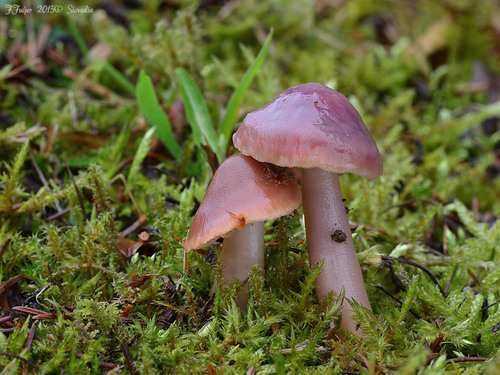
The basidiocarps of Gliophorus reginae are agaricoid, reaching up to 70 mm (2.75 in) in height. The cap ranges from hemispherical to broadly umbonate, becoming flat with age, and grows up to 55 mm (2 in) across. The cap surface is smooth, highly viscid when damp, and dull violet-purple, sometimes with pink, red, or brown undertones. The lamellae (gills) are waxy, pale and matching the cap's color, and sometimes have yellowish tints. The stipe (stem) is smooth, viscid, white, sometimes yellowish at the base, and lacks a ring. The spore print is white; under a microscope, the spores are smooth, inamyloid, and ellipsoid, measuring approximately 6 to 8.5 by 4 to 5.5 μm. Commonly called the Jubilee Waxcap, this species is currently known to occur in England and Wales, Denmark, France, Slovakia, and Spain. Like most other European waxcaps, it grows in old, agriculturally unimproved, short-sward grassland such as pastures and lawns. Recent research indicates that waxcaps are neither mycorrhizal nor saprotrophic, and may be associated with mosses.