About Gleichenia microphylla R.Br.
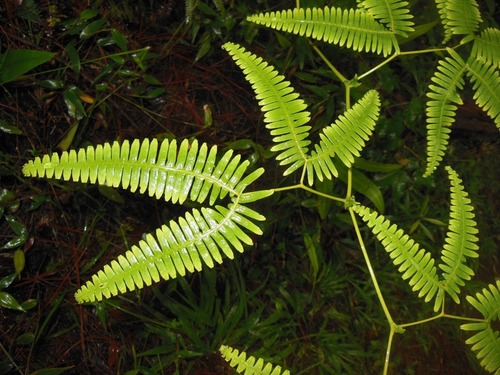
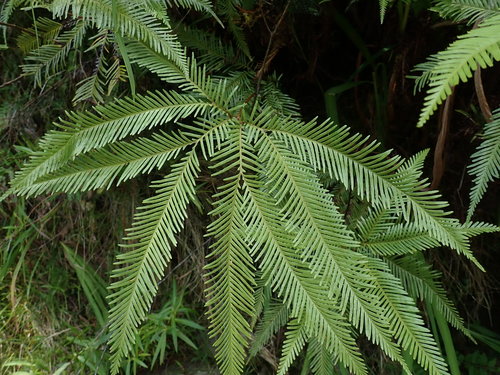
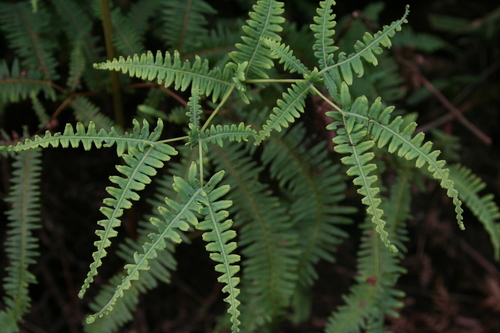
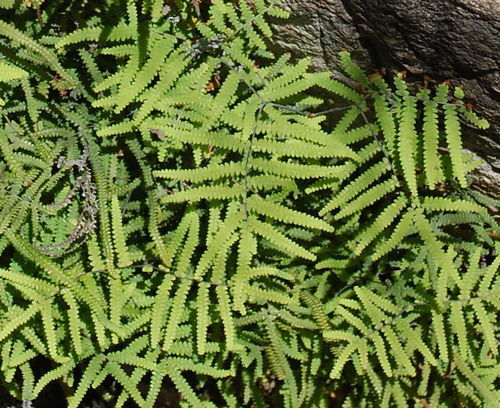
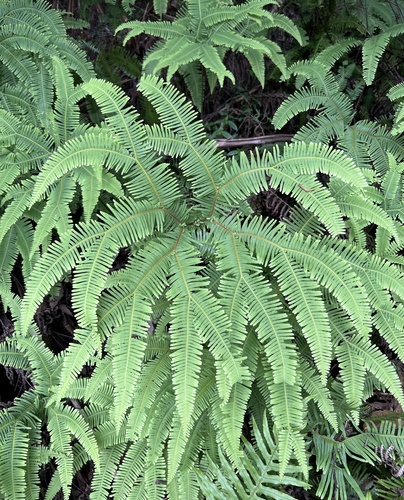
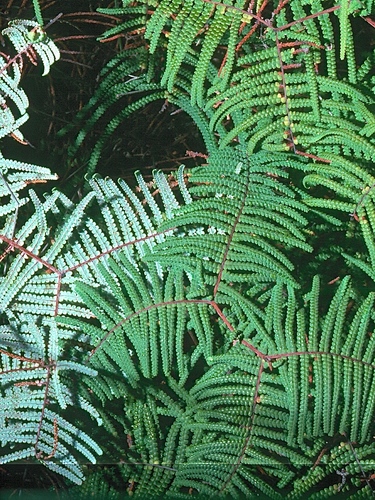
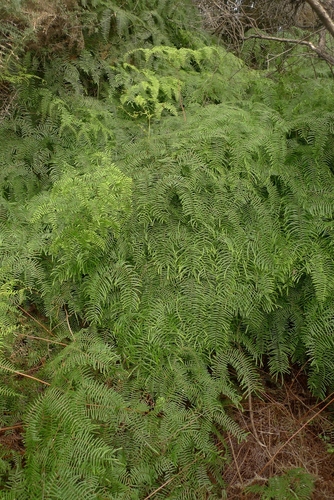
Gleichenia microphylla R.Br. has a rachis on its major branches that bears numerous conspicuous bundles of shiny, short bristles, which range in colour from amber to dark brown. It also has scattered fringed scales that are less numerous than the bristles. Its ultimate branches are linear, 2 to 6 cm long, and bear closely spaced pinnules. The undersurface of the pinna-rachis has no hairs or scales. Uncoiling new tips and young rachises are covered in red-brown bristles, with some additional fringed scales. Pinnules are 1 to 3 mm long, with a blunt, oblong-triangular shape. The lower surface of the pinnules is flat or slightly concave, and never rolls inward along all edges to form a pocket. On the underside of a fertile frond, there are 2 to 4 sori, rarely 1 or 5. The sporangia are shiny bright yellow to yellow-brown, and are arranged around a central projection. Fronds branch multiple times by forking, and reach 2 to 4 m in total length. In terms of habitat, Gleichenia microphylla forms large scrambling colonies in sunny damp locations around swamps, on exposed banks, and along creek margins. Stunted individuals are often found growing in wet rock crevices. It grows at elevations from near sea level up to 600 m above sea level, and reaches 760 m on Stewart Island, New Zealand. It is widespread across Australia and New Zealand. Some sources report that Gleichenia microphylla also occurs in Southeast Asia, Malesia, and New Caledonia, but these distribution records are not well supported. Gleichenia semivestita Labill., a synonym of Gleichenia microphylla, was previously recorded from New Caledonia, but no modern collections confirm the presence of G. microphylla on the island. It is now thought that Labillardière, who named G. semivestita from New Caledonia in 1824, mistakenly attributed Australian G. microphylla material to the location. While some Malesian plants have also been classified as G. microphylla, a portion of these plants are clearly distinct from Australian and New Zealand G. microphylla material. Reexamination of these Malesian plants is therefore needed.