About Gleichenia alpina R.Br.
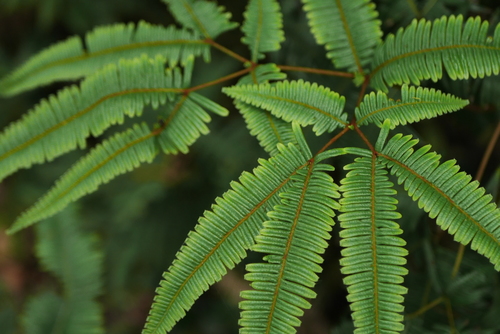
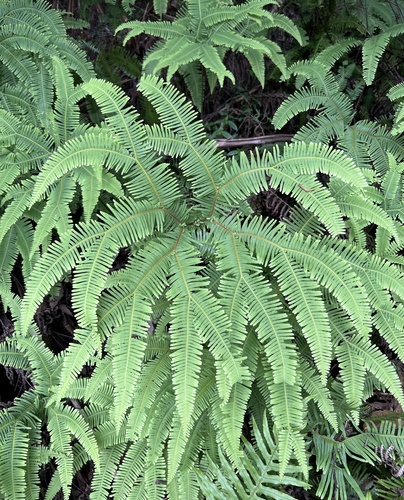
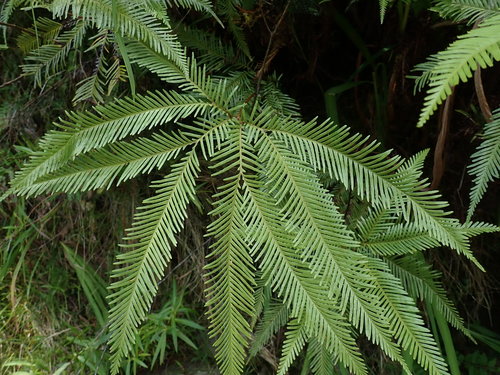
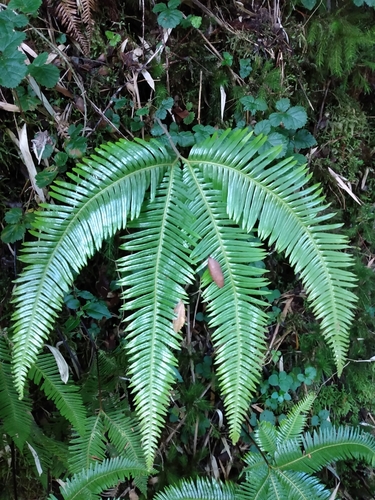
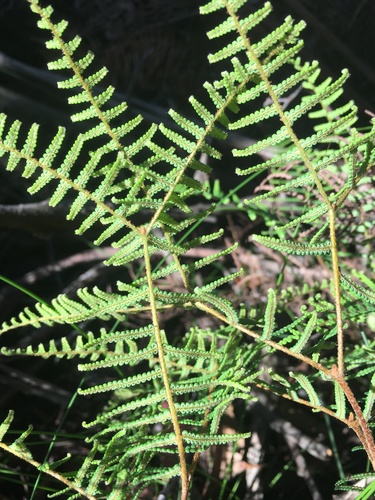
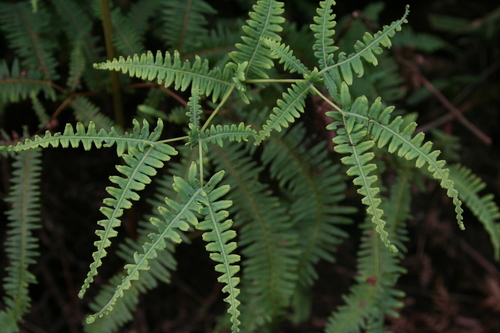
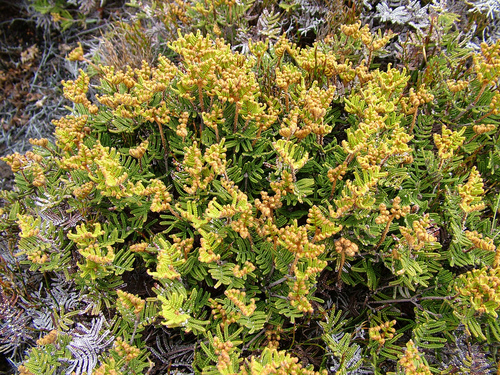
Gleichenia alpina R.Br. is a common native ground fern that grows in boggy alpine and subalpine vegetation. It has the characteristic foliage of the Gleichenia genus, which is repeatedly dichotomously divided before terminating in pinnate laminas. Its most distinctive trait is deep pouches that are densely covered in hairs on the underside of the pinnules. This species is also defined by its comparatively short frond axes, and dense orange-brown scales that fade to pale with age and cover the entire abaxial surface of the lamina. Due to its strongly pouched ultimate segments, it can only be confused with Gleichenia dicarpa. G. alpina can be distinguished from G. dicarpa by several key features: it lacks stellate scales with patent branches on the β costae; it has a strongly convex adaxial surface on its ultimate segments; its pinnae only have 0 to 1 (rarely 2) pseudodichotomous forks, excluding growth from pinna buds; it has no accessory leaflets around the rachis bud; and its pinna buds usually extend, often more than once. In contrast, G. dicarpa has stellate scales with patent branches (curled in plants from the Chatham Islands) on the abaxial and/or adaxial surfaces of the β costae; it has a complanate or weakly convex adaxial surface on its ultimate segments; its pinnae have 1 to 4 (rarely 0 or 5) pseudodichotomous forks, excluding growth from pinna buds; it usually has accessory leaflets around the rachis bud; and its pinna buds only extend occasionally, and rarely more than once. Gleichenia alpina grows in subalpine bogs, scrub, and other cold, open habitats. It typically grows in open areas, often growing through other vegetation, and only rarely extends into forest. It prefers wet ground, and is very commonly found growing alongside Empodisma. In Tasmania, it is found across all alpine areas above 700m, including the Central Plateau, Walls of Jerusalem, Cradle Valley, and Mt Field National Park. In New Zealand, it has been recorded on the North and South Islands. Its exact distribution in New Zealand is still unclear; plants that match the description of G. alpina are known from the Central Volcanic Plateau, Tākaka, and Denniston Plateau, and plants sharing the same haplotype as sampled Tasmanian G. alpina are confirmed from Mount Somers / Te Kiekie. Currently, the status of G. alpina in New Zealand requires further study, because some reduced forms of G. dicarpa are easily confused with it.