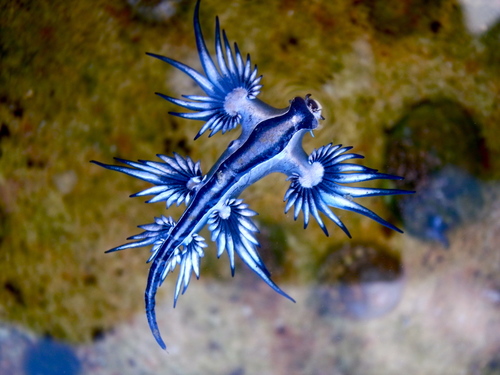
About Glaucus atlanticus Forster, 1777
At maturity, Glaucus atlanticus is usually around 3 cm (1.2 in) long, though larger specimens have been recorded. Under suitable conditions, it can live for up to one year. Its dorsal side is silvery grey, while its ventral side is patterned with dark and pale blue. Dark blue stripes mark its head. It has a flat, tapering body, with six appendages that branch into rayed, finger-like cerata. The first pair of cerata, also called papillae, extends laterally from peduncles via a short stalk; the other two groups of cerata are sessile. Within each group, the most dorsal ceratum is the largest, and other cerata decrease in size toward the ventral side. The anterior corners of the dorsal side of the foot are rounded. The center of the foot is silver, and its outer edge ranges from dark blue to brown. The papillae are arranged in a single uniseriate row, and may total up to 84, which differs from the overlapping arrangement seen in G. marginatus. G. atlanticus is typically found in tropical and subtropical areas, floating at the ocean surface thanks to stored gulped air held inside its stomach. It usually feeds on cnidarians, and feeding can be noisy because air escapes from its stomach while it eats. This species has a radula with serrated teeth; paired with a strong jaw and denticles, this structure lets it grasp and break off pieces of its prey. G. atlanticus is a pelagic nudibranch, and evidence suggests it occurs across the world's oceans in temperate and tropical waters. It has been recorded off the east and south coasts of South Africa, in European waters, off the east coast of Australia, and off Mozambique. Observations from 2015 and 2016 indicate that the species' geographical range in the Gulf of California has expanded 150 km northward compared to earlier sightings. Records of this species from the Azores date back to the middle of the 19th century. G. atlanticus was recorded in the Humboldt Current ecosystem in Peru in 2013, and off Andhra Pradesh, India in 2012; these finds align with the species' known habitat characteristics, as it thrives in warm, temperate Southern Pacific climates, and in circumtropical and Lusitanian environments. Before the 2012 recording off Andhra Pradesh, these nudibranchs had only been documented in the Bay of Bengal and off the coast of Tamil Nadu, India, locations over 677 km apart. G. atlanticus was also found off Bermuda in January 2016, and uncommonly washes ashore on east coast beaches in Barbados, Lesser Antilles. Though these sea slugs live in the open ocean, they sometimes wash accidentally onto shore, so they may also be found on beaches. Along the Brazilian Coast, the distribution of G. atlanticus is shaped by the Brazil Current and seasonal shifts in the Subtropical Convergence Zone, particularly during El Niño events. These ocean currents and weather shifts can push the species toward shore, resulting in seasonal strandings. In April 2022, specimens were found in the Gulf of Mexico along the Texas coast. On August 31, 2023 and July 11, 2025, blue sea slugs (G. atlanticus) were reported along Karon Beach, Phuket, Thailand. On July 31 and August 12, 2025, specimens were spotted on beaches in Lanzarote. On August 20 and 21, 2025, specimens were also spotted on the beach of Guardamar del Segura in Alicante, Spain (leading to several hours of beach closure), as well as on the beach of La Mata in Torrevieja, Alicante, Spain.

