About Glaucostegus cemiculus (Geoffroy Saint-Hilaire, 1817)
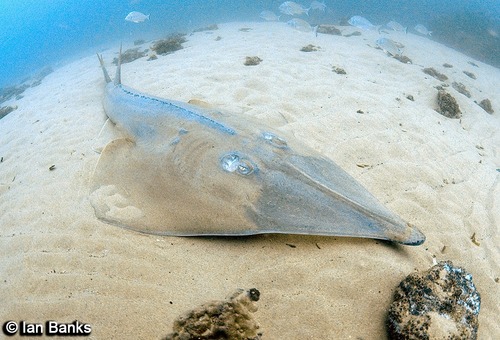
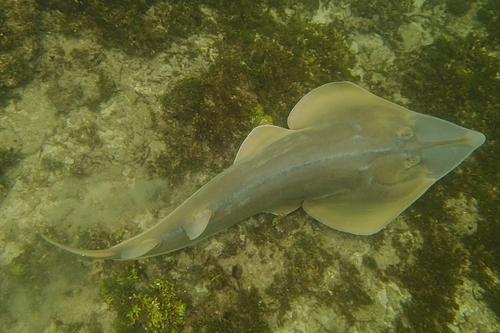
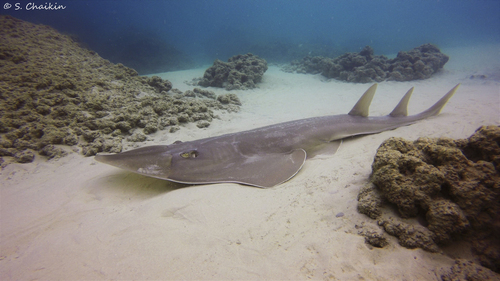
The blackchin guitarfish (Glaucostegus cemiculus) has a plain brown upper body and a white underbody, with a black blotch on its snout that is more prominent in juveniles than in adults. It shares its range with the closely related common guitarfish (Rhinobatos rhinobatos), and can be distinguished from that species by several traits: smaller eyes, narrower rostral ridges that are nearly joined at the front, a shorter front nasal lobe, and a narrower back nasal flap. Both species have short thorns along the inner eye margins, shoulders, spine, and tail, but these thorns are less distinct in the blackchin guitarfish. This species typically reaches around 180 cm (71 in) in length, though larger individuals have been reported from Guinea (West Africa) and the Gulf of Gabès in the southern Mediterranean. The blackchin guitarfish occurs in the eastern Atlantic Ocean between roughly 42°N and 17°S latitude, and 19°W and 36°E longitude. Its northernmost range limit is the northern coast of Portugal, and its southernmost limit is Angola. It is also present in the southern and eastern Mediterranean Sea, and has been recently recorded in the Black Sea. It inhabits the continental shelf at depths down to approximately 100 m (330 ft). Blackchin guitarfish swim slowly across sandy and muddy seabeds, foraging for shrimps, crabs, other crustaceans, squid, and molluscs. Males reach sexual maturity at about 150 cm (59 in) long in Senegal, and females at about 163 cm (64 in) long there; in Tunisia, males mature at 100 cm (39 in) and females at 110 cm (43 in). This species is ovoviviparous: eggs are retained inside the female's uterus, and developing embryos are nourished first by a yolk sac, and later by uterine secretions. Litter sizes range from around four to six in Senegal, while larger litters are found in Tunisia. The gestation period lasts between roughly five and eight months. In the colder months in Senegal, embryo development sometimes pauses in a diapause, but no such diapause appears to occur in Tunisia.