About Glaucosoma hebraicum Richardson, 1845
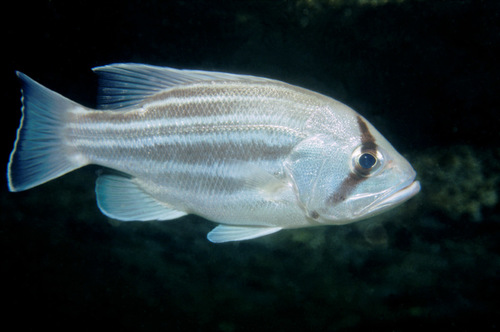
Glaucosoma hebraicum, commonly known as the dhufish, has a moderately compressed body. Adults measure around 80 cm on average, with a reported total length range of 50 to 122 cm. The species commonly reaches up to 1.2 m in total length at full maturity. Reported weights are 26 kg and 32 kg. The fish has a pearlescent silver-grey body marked by roughly six dark stripes with silver, bronze and lilac reflections. It can be distinguished from a related species found in eastern Australia by a dark vertical band across the eye, and it exhibits sexual dimorphism. Striping is prominent in juvenile dhufish, and fades as the fish matures at about three or four years old. Mature males have subtle lateral white strips stretching from the operculum to the end of the peduncle, an elongated dorsal filament, and may also have light speckling across the body. Females share body shape, size, and large black eyes with males, but differ in other features: they have a single, black, upcurved lateral line, a subtle band across the eyes, and a slightly forked emarginate caudal fin. According to "Pearl Perches of the World", the dhufish's dorsal fin has eight spines that increase in length toward the back, plus 11 soft dorsal rays. Only males have an elongated filament on the fourth dorsal ray. The anal fin has three spines followed by nine soft rays. There are 16 pectoral rays, a subtly emarginate caudal fin, four to six gill rakers, and small canine-like teeth in the upper jaw. Both sexes have a minor indentation at the front of the eyes along the body outline, large terminal upturned mouths, and pharyngeal teeth. The species has five distinct fins: the dorsal fin (with spines and rays), emarginate caudal fin, pectoral fin, pelvic fin, and anal fin (with spines and rays). Its compressed body shape enables short bursts of swimming for hunting and evading predators. The emarginate caudal fin supports propulsion and maneuverability. The spined and rayed dorsal and anal fins increase the fish's effective body size to avoid predation, and large eyes are adapted for dark waters. Dhufish reach maturity at 3 to 4 years of age and can live for more than 40 years. This species should not be mistaken for Glaucosoma buergeri, which does not exhibit sexual dimorphism and closely resembles mature female dhufish. To tell the two species apart, G. buergeri has a dark spot at the base of the end of the dorsal fin and lacks the male dorsal filament seen in G. hebraicum. A 2013 study by Parsons et al. found evidence that this species uses its swim bladder to produce vibrations for auditory communication. The dhufish is endemic to waters off Western Australia, where its range extends from Shark Bay through Augusta to Esperance and the Archipelago of the Recherche. It occurs at depths from 20 m to 200 m, and is most commonly seen between 20 and 50 m deep. It is found in coastal waters, more often on deep submerged reefs, rough bottoms, in caves, and around wreckage. It may occur in schools or roam independently. This species has high importance to local commercial fisheries, recreational fishing, and fish hatchery research. Dhufish have an average lifespan of 40 years, which makes their populations slow to recover from overfishing. As a nocturnal species, it uses its large black eyes to hunt at night, preying on smaller reef fish and crustaceans. Its upturned terminal mouth and pharyngeal teeth are suited for this diet. Its large flattened caudal fin allows it to swim in low-energy short bursts. Anal and pelvic fins aid in agility and maneuverability, and pelvic fins help the fish hold on to rocks, as it favors rocky bottoms and caves. It has been inferred that dhufish are preyed on by sharks and other large fish. This species does not migrate, but moves between different depths, frequently traveling between deep reefs and caves to shallower waters to feed and spawn during spawning season. As noted, mature males have a dorsal filament paired with small testes, which strongly suggests the species uses a lekking reproductive strategy. Its habitat is diverse, and includes the open ocean, deep and shallow waters, rocky reefs, hard bottoms, and areas high in the water column.

