About Glaucomys volans (Linnaeus, 1758)
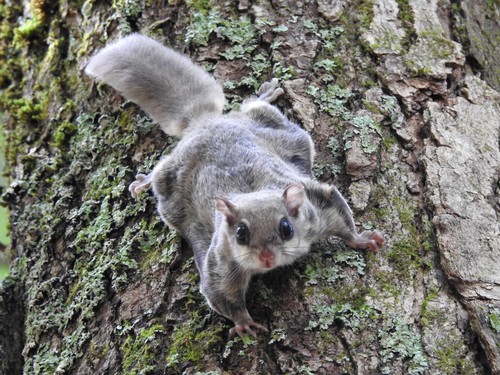
This species, the southern flying squirrel (Glaucomys volans), has grey-brown fur on its upper body, darker fur on its flanks, and cream-colored fur on its underside. It has large dark eyes, a flattened tail, and a furry membrane called a patagium that stretches between its front and rear legs, which it uses to glide through the air. The total length of an individual, including its tail, ranges from 21 to 26 cm (8.3 to 10.2 in), while the tail alone measures 8 to 12 cm (3.1 to 4.7 in). Southern flying squirrels are nocturnal. Their diet consists of fruits and nuts from trees including red oak, white oak, hickory, and beech; they store food, particularly acorns, to eat during winter. They also feed on insects, buds, mushrooms, mycorrhizal fungi, carrion, bird eggs, bird nestlings, and flowers. Their predators include snakes, owls, hawks, raccoons, and domestic cats. In both wild and captive populations, southern flying squirrels can produce two litters of young each year, with 2 to 7 young per litter. The gestation period lasts approximately 40 days. Newborns are born furless and fully helpless. Their ears open between 2 and 6 days old, and their fur is fully grown in by 7 days old. Their eyes do not open until they reach 24 to 30 days of age. Mothers wean their young 65 days after birth, and young become fully independent at around 120 days of age. Southern flying squirrels have strong homing abilities, and can return to their nests if they are artificially moved distances of up to one kilometer. Female home ranges may reach up to 40,000 m2 (430,000 sq ft), and male home ranges are typically twice this size; home ranges tend to be larger at the northern extreme of the species' range. Average home range estimates are 2.45 hectares (6.1 acres), 9 ha (22 acres), and 16 ha (40 acres) for adult males, 1.95 ha (4.8 acres), 3.9 ha (9.6 acres), and 7.2 ha (18 acres) for adult females, and 0.61 ha (1.5 acres) for juveniles. Home ranges overlap significantly with one another. Near the northern limit of the species' distribution, home ranges increase in size as mast-producing trees become more dispersed. This pattern also occurs in fragmented forests, where nesting and foraging areas are spaced widely apart. Male home ranges are larger than female home ranges, possibly to increase the chance of encountering potential mates. Even though males have larger home ranges overall, female home ranges can increase by up to 70 percent after their offspring leave. The number of nesting sites does not affect the total population size of southern flying squirrels, but it may influence which sex is present in an area. Male home ranges contain more food resources, as they are associated with a higher-than-expected number of large red oaks and white oaks. In contrast, female home ranges have lower food resources and more abundant nesting sites, which may help females avoid contact with other squirrels while raising young. Human exposure to southern flying squirrels has been linked to cases of epidemic typhus in people. Typhus spread by flying squirrels is called "sylvatic typhus." From 1976 to 2001, the U.S. Centers for Disease Control and Prevention documented a total of 39 sylvatic typhus cases linked to this species. Southern flying squirrels act as hosts for the Rickettsia prowazekii bacteria. It is hypothesized that transmission to humans occurs through aerosolized feces from fleas and lice that live on G. volans. The southern flying squirrel inhabits eastern deciduous forests or mixed forests of North America. Large hickory and beech trees are more abundant in the heavily used parts of their home ranges. Maple, poplar, and oak trees also provide favorable habitat. While southern flying squirrels may live in heavily wooded suburban areas, they never occur in large numbers in these regions. Near the northern edge of the species' range and in fragmented forests, where mast-producing trees are more dispersed and nesting and foraging areas are widely spaced, home ranges grow larger. Southern flying squirrels build nests in natural tree cavities and woodpecker holes, or construct leaf and twig nests. Leaf nests are used as refuges or resting sites, primarily during summer, while cavities are used for breeding and are used more heavily during winter. Cavities used by southern flying squirrels are found in small snags with an average diameter at breast height of 23.27 cm (9.16 in), or in large living trees with an average diameter at breast height of 50.42 cm (19.85 in). Cavity entrances average 4.7 cm (1.9 in) wide by 9.4 cm (3.7 in) high, and are located an average of 6.36 m (20.9 ft) above the ground. Dens tend to be located on the perimeter of home ranges and positioned away from clearings. To cross disturbances such as plantations and logged areas, southern flying squirrels prefer to use mature forest corridors over younger ones. This preference indicates that the species is more sensitive to forest disturbance than previously thought.