About Glaucomaria rupicola (L.) P.F.Cannon
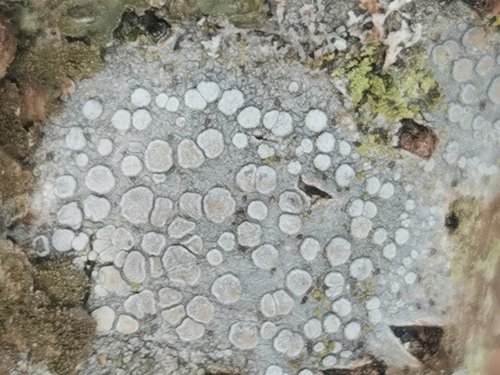
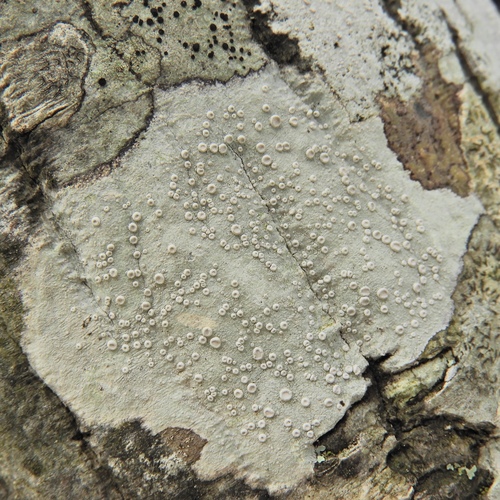
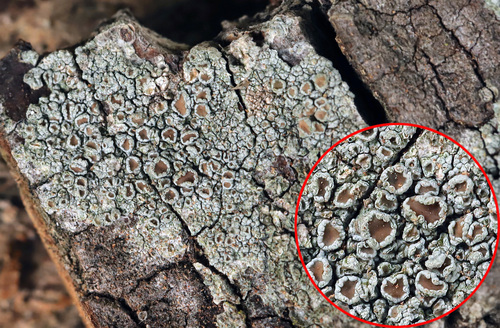
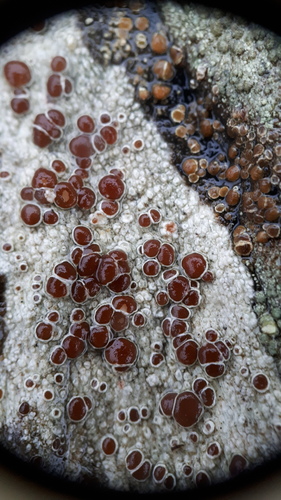
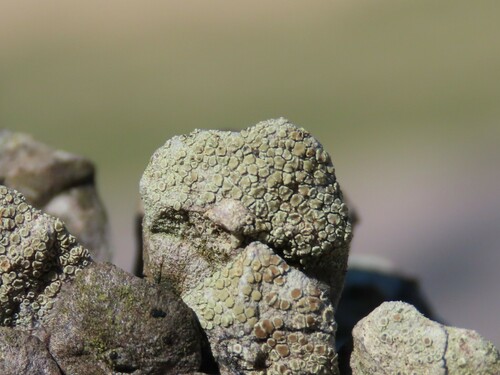
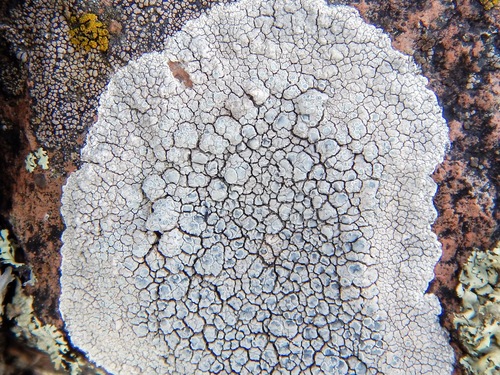
Glaucomaria rupicola (L.) P.F.Cannon is a crustose lichen. Its thallus forms continuous, clearly defined patches or a mosaic of cracked surface units, and is typically rimose (cracked), often fairly thick and uneven, with flat to slightly convex areoles. The thallus is usually white-grey, though some individuals are darker grey with greenish or brownish tints, and its surface is generally quite smooth. A prothallus is most often pale or difficult to see, but can appear grey-black where adjacent thalli of the same species meet. Soredia are usually absent, though sorediate specimens have been recorded in one named variety. Apothecia measure roughly 0.5–2 mm across, occasionally reaching 3 mm, and are either immersed in the thallus or only slightly raised. They develop either singly or in clusters where neighboring apothecial discs touch. The thalline margin is unbroken, and can be finely scalloped, wavy, or somewhat contorted, but does not rise above the surrounding thallus surface. Discs range in color from pinkish to brown, and are flat to convex; they are typically covered in a dense pale grey to blue-grey powdery coating called pruina. Microscopically, the epithecium is pale brown to dark olive-brown, and contains crystals that do not dissolve in potassium hydroxide (K). The hymenium is approximately 80–90 μm tall, with mostly unbranched paraphyses around 2–3 μm in diameter, with tips reaching about 3.5 μm. Ascospores measure roughly 9–14.5 × 5.5–7 μm, occasionally reaching 15 × 7.5 μm; conidia are slender and thread-like to slightly curved, measuring about 14–25 × around 1 μm. Spot test results for this species are: thallus C−, K+ (yellow); medulla UV+ (yellow); apothecial disc C+ (yellow), Pd−, UV+ (pale orange). Documented secondary metabolites produced by Glaucomaria rupicola include atranorin, chloroatranorin, sordidone, eugenitol, roccellic acid, and thiophanic acid. Glaucomaria rupicola has an extensive geographic range, occurring in both the Northern and Southern Hemispheres, with a described "bipolar to subcosmopolitan" distribution. In the Northern Hemisphere, it is widespread across Europe, North America, and Asia. In the Southern Hemisphere, it has been recorded in South America and other regions outside its northern range. It was first documented in the Azores archipelago, located in the North Atlantic Ocean, in 2024. A 2025 survey recorded the first report of G. rupicola in Gilgit-Baltistan, Pakistan, in the western Himalayas. Glaucomaria rupicola is a saxicolous (rock-dwelling) lichen that most often grows on hard, exposed rocky substrates. It prefers siliceous (acidic) rocks such as granite. It occurs across a wide altitudinal range, from coastal areas at sea level up to high mountain environments. On wave-exposed seashores, it is commonly found in the dry supralittoral zone just above the high-tide line, showing a strong tolerance for maritime conditions. Inland, G. rupicola also colonizes rock outcrops, boulders, and occasionally even man-made stone structures. It is common in montane and subalpine regions, and can form extensive crusts in open, well-lit habitats. While it grows predominantly on silica-rich rock, it has also been recorded growing on calcareous (limestone) substrates in some locations. Though individual populations can show ecological flexibility, overall Glaucomaria rupicola grows in cool, exposed environments where few other lichens can become dominant. In some populations, the apothecia of Glaucomaria rupicola are often darkened by Arthonia varians, a lichenicolous (lichen-dwelling) fungus. The thallus is also an occasional host for several other lichenicolous species. These include Phacographa glaucomaria, which forms small (<1 mm), rounded black apothecia with a prominent exciple, and may grow in short arcs on the host; this species is reported as rare. Other colonizers documented on G. rupicola include Lambiella insularis, which produces grey-brown to brown, sometimes olivaceous areoles and is described as locally common in some areas, and Rinodina insularis. Additional lichenicolous fungi recorded on this host are Sclerococcum montagnei, the broadly opportunistic Marchandiomyces corallinus, and Muellerella pygmaea.