About Glaucocharis lepidella Walker, 1866
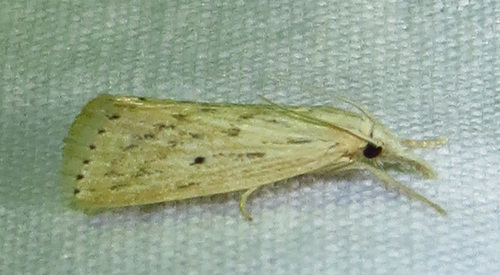
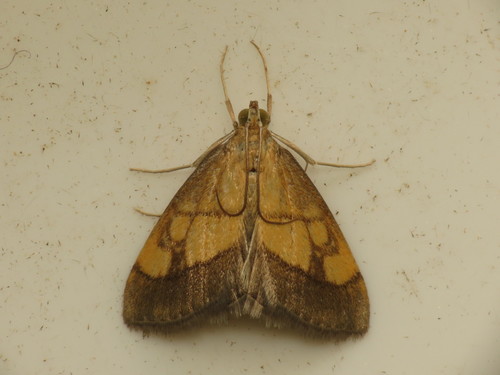
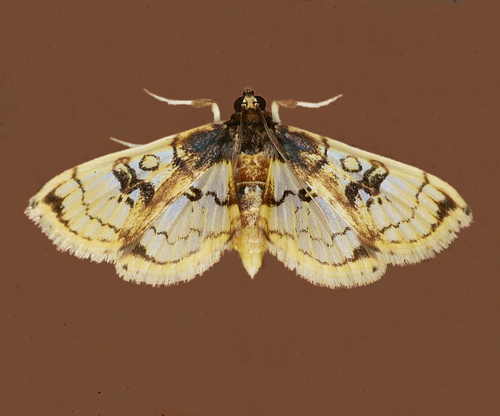
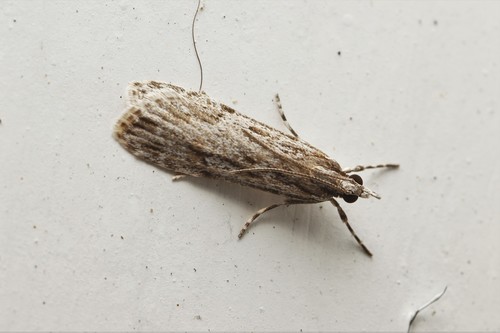
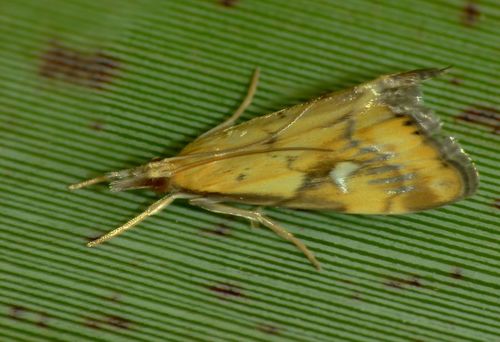
Glaucocharis lepidella was originally described by Meyrick as follows: Both male and female individuals have a wingspan ranging from 19+1⁄2 to 20+1⁄2 mm. The head, antennae, and thorax are pale ochreous. The palpi are dark fuscous, with a white base on the underside. The abdomen is whitish-grey-ochreous, and the legs are whitish-ochreous. The forewings are broad and triangular, with a slightly arched costa, rounded apex, and oblique, moderately sinuated hindmargin. Their base colour is pale yellowish-ochreous, with some brownish suffusion on the costa towards the base. A very slender, sometimes indistinct, dark fuscous transverse line runs from the costa at 1⁄3 of its length to the inner margin before the middle of the wing; the costal third of this line is straight and outwardly oblique, after which it becomes irregular, bending fairly sharply inwards just above the inner margin. Beyond the middle of the wing disc, there is a small, longitudinally oriented semicircular silvery-white spot, with its anterior angle extending narrowly and shortly upwards. A short linear dark fuscous mark sits along the middle of the costa. A second very slender, sometimes indistinct dark fuscous transverse line runs from the costa at 4⁄5 to the inner margin at 4⁄5; this line bends suddenly outwards under the costa, then curves moderately outwards, with the lower third being sinuate. Sometimes a triangular brown patch on the costa just beyond the first transverse line extends as a suffusion to below the discal spot; a small suffused brown spot on the costa a little beyond the second transverse line may sometimes produce a brown suffusion that also extends to below the discal spot, where it meets the first suffused patch. Both of these brown markings are sometimes entirely absent. Three short linear longitudinal leaden-metallic streaks cross the second transverse line above the middle, and three very similar short streaks cross it below the middle. A dark fuscous hindmarginal line is present, and three small roundish black spots sit close together on the hindmargin below the middle. The forewing cilia are shining grey, with a dark metallic-grey basal line. The hindwings are fuscous-grey, with an indistinct darker posterior line and a dark fuscous hindmarginal line; the hindwing cilia are grey, with a faint darker line. Hudson noted that this species varies considerably in the shape and size of cloudy patches on its forewings, but the white crescent-shaped discal spot is a consistent distinctive feature. Meyrick commented that the discal spot of G. lepidella is similar to that of G. leucoxantha, but G. lepidella can be distinguished from that species by its duller ground colour and grey hindwings. Meyrick also pointed out that the discal spot helps distinguish G. lepidella from G. auriscriptella, along with G. lepidella’s larger size compared to that species. Robert Hoare stated that the bright yellow to golden-orange forewing paired with its crescent-shaped silver spot is characteristic of this species. Glaucocharis lepidella is endemic to New Zealand, and can be found throughout both the North and South Islands. This species lives in lowland to subalpine native forest. Hudson reported encountering the species among low-growing bushes including hebes. It has been hypothesised that the larvae of this species feed on moss.