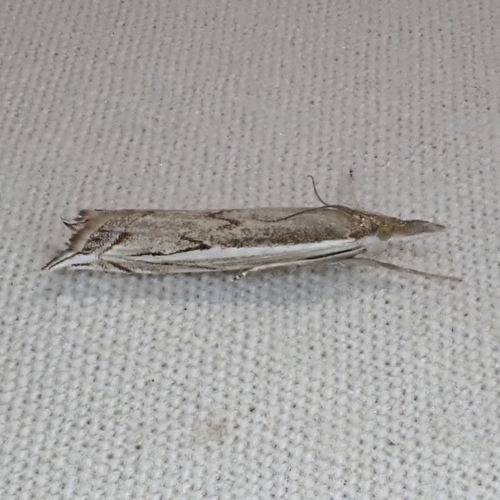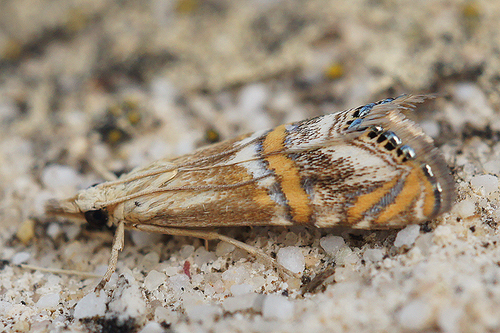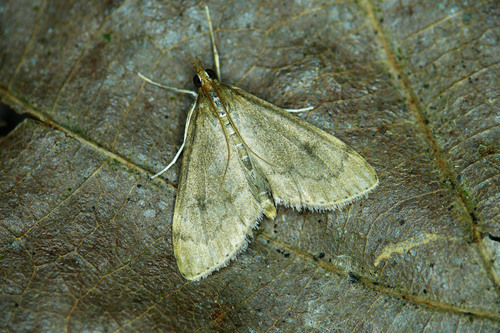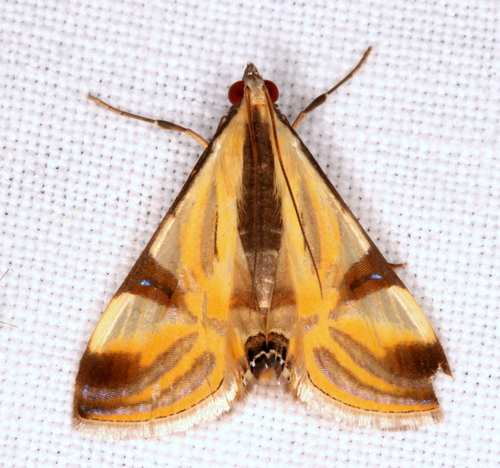
About Glaucocharis auriscriptella Walker, 1864
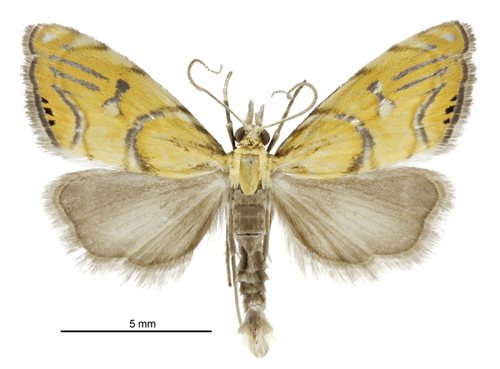
Hudson described this species as follows: The wingspan of the male is slightly over 1⁄2 inch, and that of the female is 5⁄8 inch. The fore-wings are pale golden yellow with leaden metallic markings. There is a conspicuous transverse line at about 4, which is strongly curved towards the termen in its middle section; an elongate spot sits above the middle of the wing, leaden metallic towards the costa and white towards the dorsum; a doubly curved transverse line is present beyond 3⁄4, with two long horizontal stripes between the central spot and the termen. The termen is finely edged with bronzy brown, and three minute black spots are located just before the tornus. The hind-wings and abdomen are pale grey. The female is slightly darker in overall colouring than the male, but the markings are identical in both sexes. Hudson noted that the transverse lines of some individuals may vary in width. Meyrick stated that this species can be distinguished from most similar-looking species in its genus by the discal spot on its forewings. For example, the very similar species G. holanthes can be told apart because in G. holanthes, the discal spot is instead represented by two small black dots. The exception among similar species is G. chrysochyta, which can be distinguished from G. auriscriptella by its brighter colouration and an indentation on the first transverse line of its forewings. G. auriscriptella is endemic to New Zealand. It has been observed in the North Island, the South Island, Stewart Island, and Great Barrier Island. The larvae of this species feed on mosses. It inhabits lowland and subalpine native forest, and has also been found in wetland habitat. It has been recorded on the edge of dense native bush, and adult moths appear to have an affinity for nasturtiums.