About Glaucium flavum Crantz
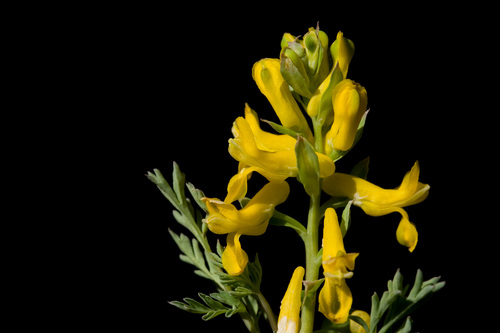
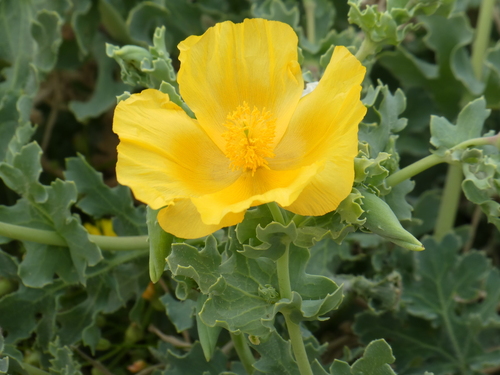
Glaucium flavum Crantz has thick, leathery, deeply segmented, wavy bluish-grey leaves covered in a water-retaining layer of wax. Its sepals, petals, and stamens share a similar structure and form with the red poppy (Papaver rhoeas), with the only difference being that Glaucium flavum sepals are not hairy. This plant grows 30–90 cm (1–3 ft) tall from branched grey stems. It blooms in summer between June and October, producing bright yellow or orange flowers that measure 7.5 cm (3 in) across. After flowering, it develops a very long, upright, thin, distinctively horn-shaped capsule 15–30 cm (6–12 in) long. This capsule is split into two chambers that open to release the plant's seeds. It is native to temperate regions of North Africa, Europe, and parts of Western Asia. Its confirmed range includes North Africa: Macaronesia, the Canary Islands, Algeria, Libya, Tunisia, and Morocco; Western Asia: the Caucasus, Georgia, Cyprus, Sinai (Egypt), Lebanon, Syria, and Turkey; Eastern Europe: Ukraine; Middle Europe: Belgium, Germany, Netherlands, and Slovakia; Northern Europe: Denmark, Ireland, Norway, Sweden, and the United Kingdom; South-eastern Europe: Albania, Bosnia and Herzegovina, Bulgaria, Croatia, Greece, Italy, Montenegro, Sicily, Malta, North Macedonia, Romania, and Slovenia; South-western Europe: France, Portugal, and Spain. It grows primarily in coastal habitats, including shingle banks and beaches, and can also be found on cliff tops and in sand dunes. When cut open, the plant produces orange, foul-smelling sap. All parts of Glaucium flavum, including the seeds, are toxic. If ingested, it can cause a wide range of symptoms, and may lead to respiratory failure and death. The main alkaloid found in Glaucium flavum is glaucine. Glaucine has bronchodilator and anti-inflammatory effects, acts as a PDE4 inhibitor and calcium channel blocker, and is used medically as an antitussive in some countries. Known side effects of glaucine include sedation, fatigue, and a hallucinogenic effect marked by colourful visual images, and it has been used as a recreational drug. A detailed bibliography covering glaucine and Glaucium flavum is available from the National Agricultural Library. Historically in Hampshire, UK, this plant was called 'squatmore', and its roots were used to treat bruises and pains in the breast, stomach, and intestines.