About Glaucis hirsutus (J.F.Gmelin, 1788)
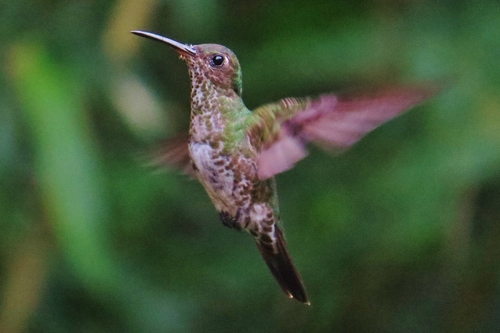
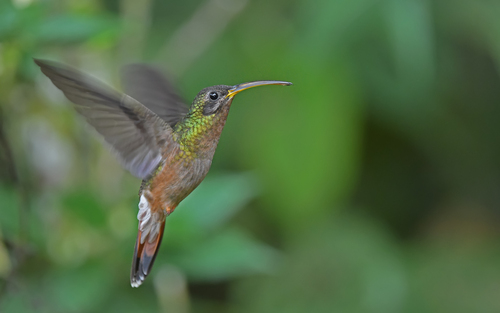
The rufous-breasted hermit (Glaucis hirsutus) averages 10.7 cm (4.2 in) long and weighs 7 g (0.25 oz) on average. Its bill is around 3.3 cm (1.3 in) long, strongly decurved, long and thin, and rather robust compared to the bills of other hummingbirds. This species has a brownish head, bronze-green upperparts, and rufous underparts. Its tail has green central feathers and rufous outer feathers, and all tail feathers are tipped white. The bill has a yellow lower mandible and a black upper mandible. The sexes are similar in appearance, but males have yellow streaking on the upper mandible, while females may have slightly duller plumage. Female bills are also proportionally slightly shorter (a difference that is barely noticeable) and more decurved (a difference that is quite obvious when comparing individuals directly). Males are somewhat more distinct in appearance and resemble barbthroats (genus Threnetes). Males were once described as a separate species called the "black barbthroat" (T. grzimeki). Similarly, the proposed subspecies abrawayae is based on individual variation in adult birds and is not taxonomically distinct. The call of this species is a high-pitched sweet. This hermit lives in forest undergrowth, often near running water. It feeds on nectar from a variety of understory flowers, as well as some small invertebrates. G. hirsutus has very discriminating feeding habits: it only visits flowers whose corolla length and curvature exactly matches the shape of its bill, while most other hummingbirds are much more flexible in the flowers they use. Because of this, its food plants come from almost the entire diversity of angiosperms. Zingiberales, such as Costus scaber (Costaceae), Heliconia standleyi, and Heliconia stricta (Heliconiaceae) are very popular food plants for this hummingbird. Other favored food plants include Gentianales such as Duroia hirsuta, Palicourea lasiantha, Psychotria bahiensis, and Psychotria platypoda (Rubiaceae), Lamiales such as Sanchezia peruviana (Acanthaceae) and Drymonia semicordata (Gesneriaceae), and Myrtales such as Cuphea melvilla (Lythraceae). On the other hand, the hummingbird even avoids congeneric plants with flowers that have slightly different length and curvature. Given the difference in bill curvature between males and females, it is likely that the sexes avoid competing for the same food resource by visiting different plants, but little in-depth research has been done on this topic. It is difficult to determine whether coevolution has occurred between this hummingbird and its food plants, but any coevolution that has happened is apparently less widespread than might be assumed. Most plants visited by this hummingbird are also pollinated by less discriminating species. However, for some plants such as Cuphea melvilla, Psychotria bahiensis and P. platypoda, the rufous-breasted hermit appears to be a critically important pollinator. This shows that strong mutualisms between this bird and some of its food plants do exist, even though they are less common than the species' characteristic bill shape would suggest.