About Glaucidium siju (d'Orbigny, 1839)
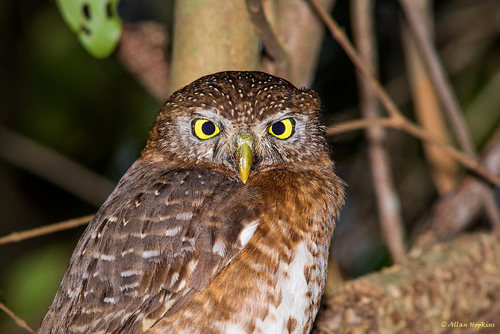
The Cuban pygmy owl (Glaucidium siju) is 16 to 17 cm (6.3 to 6.7 in) long. Males weigh 47 to 68 g (1.7 to 2.4 oz) and females weigh 66 to 102 g (2.3 to 3.6 oz). It has two color morphs, gray-brown and rufous, with the gray-brown morph being more common. Both morphs have a pale grayish face, whitish to cinnamon 'brows' above yellow eyes, and a pair of dark 'false eyes' on the nape. For the nominate gray-brown morph, the crown, sides of the head, and back are grayish brown with white spots; the shoulders have diffuse dark barring. The tail is also grayish brown, with white bars. The throat is brown, the sides of the breast and flanks are brown with darker bars, the center of the breast is white, and the remaining underparts are off-white with dark brown streaks and spots. The rufous morph has cinnamon coloration in place of the gray-brown seen in the nominate morph. The subspecies G. s. turquinense is much darker and has fewer spots on its upperparts. The subspecies G. s. vittatum is larger than the nominate subspecies, and the barring on its shoulders is more defined. The Cuban pygmy owl is the most common and most frequently observed owl in Cuba. The nominate subspecies occurs across the main island of Cuba, except on its highest mountain, Pico Turquino. Subspecies G. s. turquinense is found only on Pico Turquino, while G. s. vittatum occurs on the Isla de la Juventud (Isle of Pines) and possibly on the Guanahacabibes Peninsula. This species inhabits the interiors and edges of coastal, deciduous, and montane forest, including both primary and secondary forest. It can also be found in areas like pastures with scattered trees, cultivated fields, plantations, and large city parks. Its elevational range extends from sea level up to 1,500 m (4,900 ft).